

Surf instructor essentials for your Portugal surf holiday

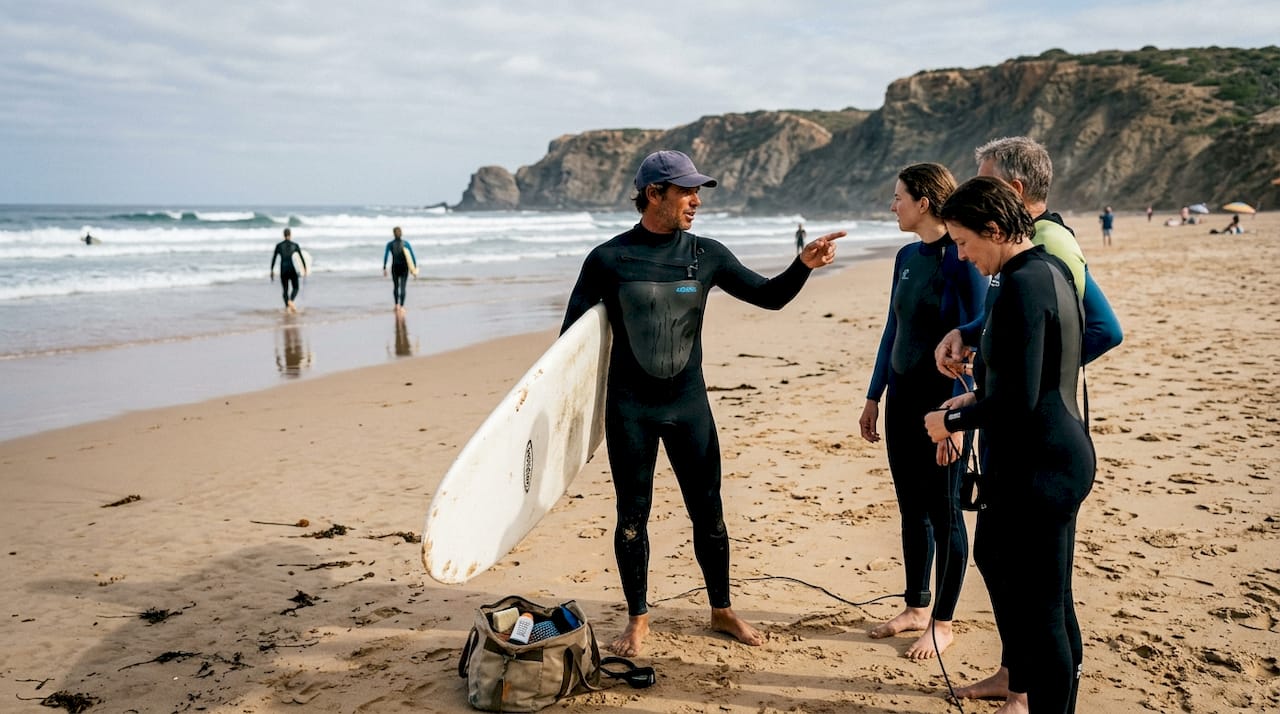
Many aspiring surfers imagine that learning to surf is as simple as grabbing a board and paddling out. The reality is far more complex. Ocean conditions shift constantly, wave dynamics require deep understanding, and safety protocols demand expertise. This is where a skilled surf instructor becomes essential. Beyond teaching you to stand up, certified instructors ensure your progression is safe, efficient, and tailored to Portugal’s stunning coastal environment. This guide reveals what surf instructors actually do, the methods they use, their required certifications, and how they create personalized experiences for adventure tourists exploring Portugal’s world-class surf spots.
Table of Contents
Key Takeaways
Point | Details |
Certified instructors ensure safety | Certified instructors assess tides and conditions and tailor lessons to Portugal’s coast to keep beginners safe. |
Two hour lesson structure | Most sessions run two hours with beach theory followed by in water practice to build fundamentals. |
Small groups maximize learning | Instructors typically teach in small groups up to six students to provide personalized feedback while staying safe. |
Ocean literacy and safety | Instructors teach ocean literacy to help you read waves, identify rip currents, and enter and exit the surf zone safely. |
What does a surf instructor do? Exploring the role in Portugal
Surf instructors in Portugal manage far more than just pushing boards in the whitewater. Their role begins hours before you arrive at the beach. Each morning, certified instructors assess tides, swell direction, wind conditions, and sandbank formations to select the safest, most productive teaching location for the day. This logistical expertise separates professional instruction from casual beach guidance.
Certification standards in Portugal are rigorous. Professional surf instructors typically hold Level I or Level II Surf Coach credentials from the Portuguese Surf Federation, or equivalent ISA (International Surfing Association) qualifications. These certifications require demonstrated surfing ability, safety training, teaching methodology coursework, and first aid certification. When you book with certified instructors, you’re accessing professionals who’ve proven their competence through standardized evaluation.
The teaching approach centers on small groups. Most reputable surf schools in Portugal maintain a maximum ratio of six students per instructor. This allows personalized attention to your specific challenges, whether that’s paddling technique, timing your pop-up, or managing fear when waves approach. Instructors constantly scan their group, providing individual feedback while maintaining overall safety awareness.
Beyond technique, instructors teach ocean literacy. They explain how to safely enter and exit the surf zone, read wave patterns, identify rip currents, and position yourself correctly in the lineup. This knowledge prevents common beginner injuries like board-to-face impacts, ankle twists from improper stance, and exhaustion from fighting currents instead of working with them.
Mental coaching forms another crucial dimension. Many beginners experience anxiety when confronting the ocean’s power. Skilled instructors recognize fear responses and provide encouragement tailored to your comfort level. They’ll adjust wave size exposure gradually, building confidence through manageable progressions rather than overwhelming you.
Pro Tip: Before booking surf lessons in Portugal, verify that instructors hold current Portuguese Surf Federation or ISA certifications. Ask about their maximum group sizes and teaching philosophy. Legitimate schools proudly display credentials and explain their safety protocols.
How surf instruction works: teaching methods and typical lesson flow
A standard surf lesson in Portugal follows a proven structure designed to maximize your water time while building foundational understanding. Most sessions last two hours, strategically divided between theory and practice. The first 20 minutes occur on the beach, where instructors explain wave formation, paddling mechanics, the pop-up sequence, and safety protocols. This beach theory accelerates your in-water learning because you understand the “why” behind each movement.
The remaining 90 minutes happen in the ocean. Instructors guide you through progressive stages:
Paddling practice in calm water to develop board balance and stroke efficiency
Positioning in the whitewater zone where broken waves provide gentle, consistent push
Instructor-assisted wave catching, where they push your board to ensure proper speed and timing
Independent attempts with real-time feedback on positioning, paddling intensity, and pop-up execution
Gradual reduction of assistance as you develop wave-reading skills and timing instincts
Beginner progression follows predictable milestones. Most students stand on whitewater waves by their second or third lesson. This rapid improvement results from structured instruction rather than trial and error. Instructors identify your specific technical gaps (often timing or weight distribution) and provide targeted corrections that would take months to discover independently.
Dry land practice proves surprisingly valuable. Before entering the water, you’ll rehearse pop-ups on the sand dozens of times. This muscle memory development means your body executes the movement automatically when a wave arrives, freeing your mind to focus on balance and positioning. The repetition feels tedious initially, but pays dividends when you’re actually riding waves.
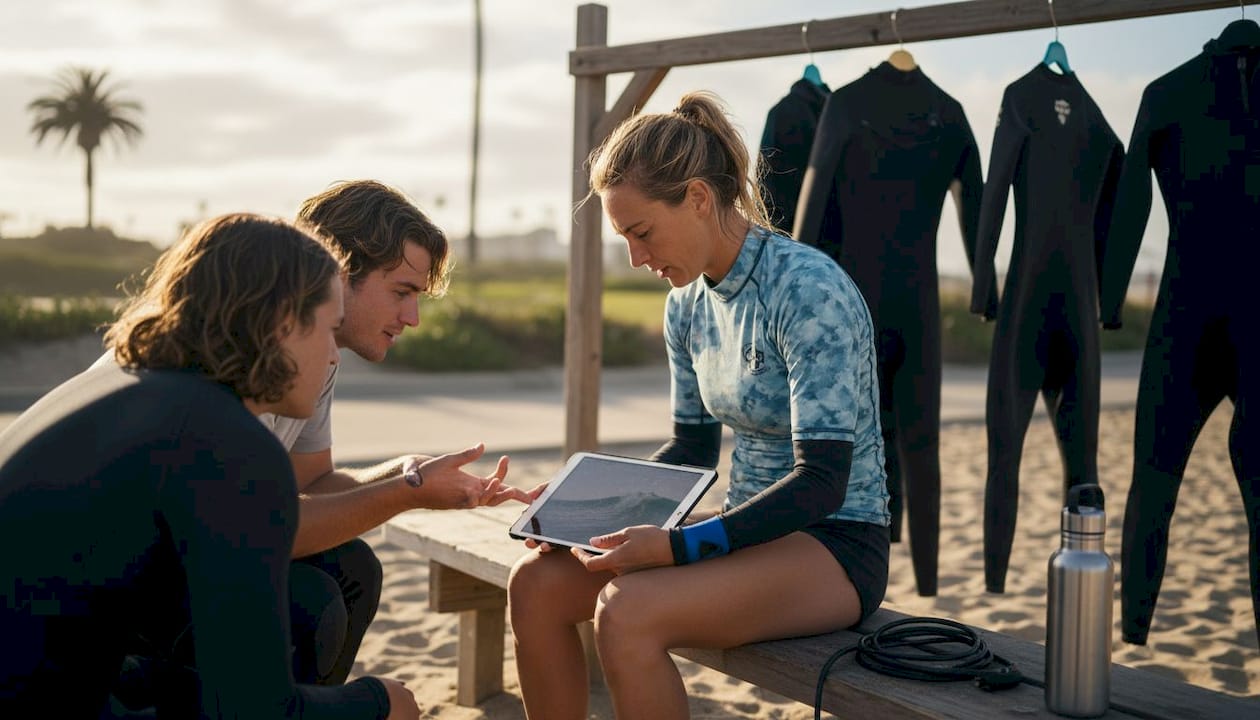
Intermediate surfers benefit from advanced teaching tools. Video analysis allows you to see your technique from outside perspectives, revealing issues invisible to you in the moment. Many Portugal surf schools now offer this feedback, filming your sessions and reviewing footage to highlight specific improvement areas. Surfskate boards (land-based training tools that mimic surfing movements) help refine turning mechanics and build the core strength essential for progression.
Lesson Component | Duration | Primary Skills Developed | Teaching Method |
Beach theory | 20 minutes | Wave dynamics, safety protocols, pop-up sequence | Instructor demonstration, visual aids, Q&A |
Paddling practice | 15 minutes | Board balance, stroke efficiency, ocean comfort | In-water guidance, posture correction |
Whitewater catching | 45 minutes | Timing, pop-up execution, wave selection | Instructor-assisted catches, progressive independence |
Independent attempts | 30 minutes | Decision-making, confidence, technique refinement | Real-time feedback, video recording |
Group size directly impacts learning quality. With six students maximum, instructors spend approximately 10 minutes per hour providing you individualized attention. Larger groups dilute this focus, leaving you to figure out problems independently. The investment in smaller classes accelerates your progression significantly.
Pro Tip: Book consecutive lessons over multiple days rather than spreading them across weeks. Daily practice embeds muscle memory and ocean understanding faster than sporadic sessions. Many surf camps in Portugal structure programs around this principle, offering 5-day intensive courses that transform complete beginners into confident wave riders.
Essential surf instructor skills and safety knowledge
The gap between recreational surfer and qualified instructor is substantial. Teaching surfing demands technical mastery far beyond casual wave riding. Certified instructors must demonstrate proficiency across core skills that most recreational surfers never fully develop.
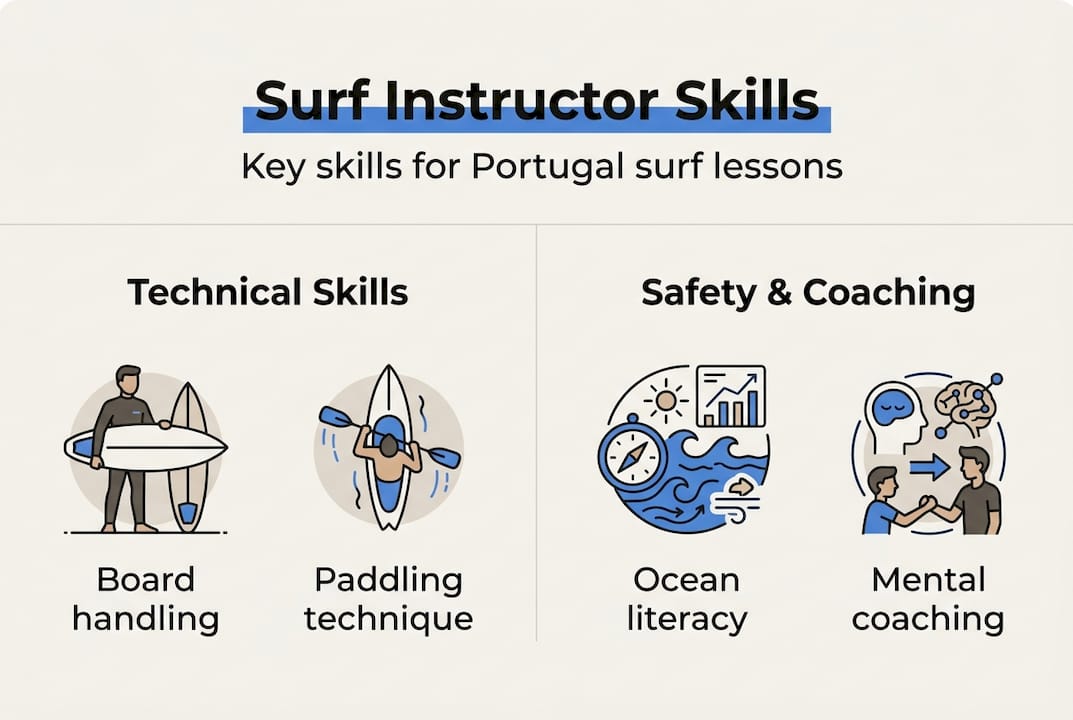
ISA Level 1 certification requires efficient paddling technique that conserves energy over extended periods, duck diving ability to navigate through broken waves (or turtle rolling for longboards), controlled take-offs in various wave conditions, speed generation through pumping and weight transfer, functional bottom turns that set up maneuvers, and safe exit strategies from the surf zone. Instructors must perform these skills comfortably in head-high waves, maintaining composure that allows them to simultaneously monitor students.
This technical foundation enables effective teaching. When you struggle with a specific movement, instructors draw from their own refined technique to diagnose your issue and prescribe corrections. A recreational surfer might stand up successfully but lack the analytical understanding to explain why certain movements work. Certified instructors possess both practical ability and pedagogical knowledge.
Skill Category | Recreational Surfer Level | Required Instructor Level |
Paddling | Basic forward motion | Efficient stroke mechanics, sprint capability for rescues |
Duck dive/turtle roll | Occasional success in small waves | Consistent execution in overhead conditions |
Pop-up | Functional but inconsistent | Smooth, repeatable, teachable in stages |
Wave selection | Trial and error approach | Reading sets, predicting break points, positioning students optimally |
Safety awareness | Personal risk management | Group supervision, rescue skills, first aid certified |
Safety knowledge extends beyond surfing technique into comprehensive ocean literacy. Instructors assess multiple environmental factors before each lesson:
Wave type and size relative to student ability levels
Sandbank formations that create safe teaching zones versus hazardous shore breaks
Current patterns including rip currents that could sweep beginners offshore
Tidal timing that affects wave quality and ocean floor depth
Weather conditions including wind direction, visibility, and approaching storms
Marine life considerations specific to Portuguese waters
Mental coaching ability separates good instructors from great ones. Fear responses to ocean power are natural and varied. Some students freeze when waves approach, others paddle frantically in wrong directions, and many tense their bodies in ways that guarantee falls. Skilled instructors recognize these patterns and provide calming guidance tailored to individual psychology. They know when to encourage pushing boundaries versus when to scale back intensity.
Common beginner injuries result from technique errors that proper instruction prevents. Board-to-face impacts occur when students pop up with the board too far forward. Ankle sprains happen from landing with locked joints instead of bent knees. Shoulder strains develop from inefficient paddling that overworks small muscles. Exhaustion strikes those who fight waves instead of timing movements with ocean rhythms. Each of these issues becomes manageable with experienced instructor guidance that corrects form before bad habits solidify.
Pro Tip: During your first lesson, observe how instructors position themselves relative to students. Quality instructors maintain constant visual contact with their entire group, positioning themselves to intervene quickly if anyone struggles. This spatial awareness indicates professional training and genuine safety commitment.
Tailoring surf lessons for adventure tourists in Portugal’s coastal environment
Portugal’s coastline presents unique teaching opportunities and challenges that skilled instructors navigate daily. The Atlantic Ocean delivers consistent swell year-round, but conditions vary dramatically between morning and afternoon, between beaches separated by mere kilometers, and across seasons. This variability requires adaptive teaching that recreational surfers rarely develop.
Instructors make location decisions based on real-time assessment. A beach perfect for teaching yesterday might be unsuitable today due to shifted sandbars, increased swell size, or changed wind direction. Professional surf schools maintain relationships with multiple beach locations, allowing them to relocate lessons to optimal conditions. This flexibility ensures you’re always learning in environments matched to your current ability.
Small group instruction combined with video analysis creates personalized learning experiences that generic group lessons can’t match. Your instructor identifies your specific technical gaps, whether that’s weight distribution during pop-up, paddle timing relative to wave arrival, or stance width affecting balance. Video feedback makes these issues visible, transforming abstract coaching into concrete visual evidence of what needs adjustment.
Beach theory sessions accelerate understanding in ways that pure practice cannot achieve. When instructors explain why waves break where they do, how sandbars channel water flow, and what visual cues indicate good versus poor wave selection, you develop ocean intelligence that informs every subsequent decision. This knowledge compounds over time, making each lesson more productive than the last.
Instructors adapt teaching approaches based on multiple factors:
Wave type expectations: gentle rollers for first-timers versus steeper faces for progressing students
Local hazards: rocky outcrops at certain beaches, strong currents at specific tidal stages
Student skill levels: mixed-ability groups receive differentiated instruction within the same session
Mental readiness: confidence levels that determine appropriate challenge intensity
Physical conditioning: energy management across multi-day surf programs
The scenic Algarve and Lisbon coasts offer more than just quality waves. The natural beauty, authentic beach village atmosphere, and welcoming local culture create memorable experiences beyond the surfing itself. Professional instructors understand they’re facilitating adventure tourism, not just teaching a sport. They share local knowledge about the best post-surf cafes, explain Portuguese surf culture, and help you connect with the coastal environment in meaningful ways.
This holistic approach transforms surf lessons into complete holiday experiences. You’re not just learning to stand on a board. You’re developing ocean confidence, understanding a new environment, challenging yourself physically and mentally, and creating stories you’ll share for years. Skilled instructors recognize this broader context and shape lessons accordingly.
Personalized surf instruction accounts for individual learning styles. Some students grasp concepts through verbal explanation, others need visual demonstration, and many require kinesthetic repetition. Effective instructors vary their teaching methods to match your preferences, ensuring information lands in ways you can actually use.
The Portuguese coastal environment rewards this adaptive approach. Water temperatures remain comfortable year-round with appropriate wetsuit selection. Wave consistency means missed sessions due to flat conditions are rare. Beach accessibility and infrastructure support convenient lesson logistics. These factors combine to create ideal learning conditions when paired with professional instruction.
Plan your surf holiday with certified instructors
Experiencing Portugal’s world-class waves with professional guidance transforms your surf holiday from frustrating trial-and-error into confident, rapid progression. Ripar Surf School brings over two decades of teaching expertise to Praia Areia Branca, offering certified instructors who understand both surf technique and the unique conditions along Portugal’s premier coastlines. Our small group approach ensures personalized attention whether you’re catching your first whitewater wave or refining your green wave technique.
We offer flexible options for every learning style and schedule. Group surf lessons provide energetic, social learning environments with maximum six students per instructor. Private coaching delivers intensive, customized instruction for rapid skill development. Multi-day surf camps immerse you in comprehensive programs combining daily lessons, equipment, and accommodations in our authentic beach village setting. Book online to secure your spot with instructors who prioritize safety, technique, and creating memorable Portuguese surf experiences.
Frequently asked questions
What qualifications should a surf instructor have?
Look for Portuguese Surf Federation certification or ISA Level I credentials at minimum. These certifications require demonstrated surfing ability, safety training, teaching methodology knowledge, and first aid certification. Experience teaching small groups and adapting to changing ocean conditions indicates practical expertise beyond basic credentials.
How quickly can beginners expect to stand up on a surfboard?
With guided instruction, most beginners stand on whitewater waves by their second or third lesson. Progression speed depends on fitness level, ocean comfort, and practice frequency. Consecutive daily lessons accelerate learning compared to weekly sessions because muscle memory and ocean understanding develop through consistent repetition.
What safety measures do surf instructors follow during lessons?
Instructors assess wave and tide conditions before each session to select appropriate teaching locations. They teach safe ocean entry and exit techniques, maintain constant visual contact with all students, and provide mental coaching to manage fear responses. Professional instructors hold first aid certification and carry safety equipment for emergency response.
Can intermediate surfers benefit from professional instruction?
Absolutely. Intermediate surfers often plateau without identifying specific technical limitations. Video analysis reveals subtle form issues invisible during riding. Instructors provide structured progression frameworks for developing turns, generating speed, and reading unbroken waves. Many intermediate surfers advance more in one intensive week with coaching than in months of independent practice.
What makes Portugal ideal for learning to surf?
Portugal offers consistent Atlantic swell year-round, comfortable water temperatures with wetsuits, diverse beach breaks suitable for all levels, and welcoming surf culture. The coastline provides protected bays for beginners and challenging reef breaks for advanced surfers within short distances. Quality instruction combined with scenic environments and authentic coastal villages creates complete surf holiday experiences.
Recommended
Comments