

What Is Sustainable Surf Tourism and Why It Matters


TL;DR:
Sustainable surf tourism (SST) is a structured approach that actively manages environmental, social, and economic impacts on coastal communities. It emphasizes community leadership, governance, and low-impact practices to ensure long-term destination viability and reef health. Travelers can support genuine SST by choosing locally owned operations with enforceable rules, transparent governance, and community involvement.
Surf tourism has exploded over the past two decades, drawing millions of travelers to coastal communities worldwide. But here’s what most surf travelers miss: showing up with a reusable water bottle doesn’t make your surf holiday sustainable. Sustainable surf tourism, or SST as researchers increasingly label it, is a structured approach to surf travel that actively manages environmental, social, and economic pressures on coastal destinations. This article breaks down what that really means, how it works in practice, and what you can do to tell the difference between genuine SST and greenwashing.
Table of Contents
Key Takeaways
Point | Details |
SST is a structured approach | It systematically addresses ecological and social harms from surf travel, not just surface-level eco gestures. |
Community leadership is central | Local stewardship and economic participation define the most successful sustainable surf destinations. |
Governance matters more than individual behavior | Marine protected area policies and certification frameworks shape outcomes more than any single traveler’s choices. |
Operational rules signal authenticity | Specific behavioral constraints like plastic bans and quiet-hour rules are better sustainability signals than vague eco-claims. |
Traveler experience drives long-term impact | High-quality surf experiences build destination loyalty, which funds ongoing conservation investment. |
What is sustainable surf tourism: principles and pillars
Surf tourism, at its core, means traveling to ride waves. Sustainable surf tourism means doing that without degrading the coastlines, reefs, and communities that make those waves worth surfing. A 2026 study in Sustainability frames SST explicitly around mitigating ecological and social externalities from tourism development while supporting long-term destination viability. It connects directly to UN Sustainable Development Goal 14, which focuses on life below water.
The framework rests on three interlocking pillars:
Environmental: Protecting marine ecosystems, reef health, water quality, and coastal habitats through low-impact operations and visitor management.
Social: Prioritizing local community wellbeing, cultural integrity, and fair economic participation rather than funneling profits to outside operators.
Economic: Creating financial models where conservation and tourism reinforce each other rather than compete. Healthy reefs attract surfers. Revenue from surfers funds reef protection.
What makes SST distinct from general eco-tourism is its focus on wave-specific resources and the surf culture that surrounds them. Breaks are finite, fragile resources. Overcrowding a reef pass or dumping sewage near a point break doesn’t just harm the environment. It destroys the very asset the destination depends on. SST requires industry standards and low-impact coastal development, not just on-site eco gestures, to keep destinations viable over decades.
Pro Tip: When researching a surf destination, look for SST commitments that address infrastructure and policy, not just recycling programs. Policy-level action is where real environmental protection happens.
Real-world examples of sustainable surf operations
Understanding SST principles is one thing. Seeing them in action makes the concept concrete. Some of the most instructive examples come from Southeast Asia, where surf tourism pressure on fragile reef ecosystems forced communities to get creative.
In Sorsogon, Philippines, a surf and eco-camp built its entire operational model around community consensus. The camp bans single-use plastics and uses bamboo showers and nipa huts instead of concrete structures. Rules against alcohol and loud music at night aren’t suggestions. They’re enforced by the 72-member community group that has governed the operation since 2014. That last part matters enormously. Sustainability enforced by the people whose lives depend on it looks completely different from sustainability marketed by an outside resort owner.

On Siargao Island, community surf guides act as stewards of the reef, interpreting local culture for visitors while managing access to sensitive sites like Sugba Lagoon. Activities like kayaking and cultural interpretation replace extractive or high-impact alternatives, keeping the experience connected to conservation.
Here’s what to look for when evaluating any surf operation’s sustainability claims:
Explicit behavioral rules posted and enforced on-site, not just listed in a brochure
Local ownership or meaningful profit-sharing with the community
Built infrastructure using natural or low-impact materials
Named partnerships with local conservation or governance bodies
Visitor caps or booking limits that protect the resource
Pro Tip: Ask your surf camp who owns it and where the staff are from. A locally owned operation with local employees is almost always more genuinely sustainable than a foreign-owned resort with an eco badge.
The role of governance and certification
Individual operators can commit to all the right practices and still fail if the broader governance environment is broken. Governance capacity in marine protected areas is one of the strongest predictors of whether ecotourism succeeds or degrades the resource it depends on. Studies from Macaronesia highlight how fragmented management structures create overlapping jurisdictions that make coordinated conservation nearly impossible.
Certification programs help fill this gap by setting measurable standards that operators can work toward and travelers can verify. Ecotourism Australia’s certification model is one of the most developed, covering 500 certified operators and 1,700 experiences under ECO and Climate Action standards. Certification builds a bridge between tourism economics and conservation goals by requiring operators to document their practices and submit to independent review.
Here’s a practical comparison of what different governance approaches look like for surf destinations:
Governance model | Strengths | Weaknesses |
Government-led MPA management | Legal authority, enforcement power | Often slow, underfunded, and disconnected from local communities |
Community-based management | Locally adapted, high compliance, culturally grounded | Can lack legal backing or technical resources |
Third-party certification (e.g., Ecotourism Australia) | Transparent standards, traveler-verifiable | Voluntary participation means many operators opt out |
Hybrid models (government + community + NGO) | Combines legal authority with local knowledge | Coordination is complex but produces the best outcomes |
The fragmentation problem in MPAs is real, and it won’t be solved by individual surfers making better choices. Regional cooperation between governments, communities, and certification bodies is what moves the needle at scale. As a traveler, choosing certified operators sends economic signals that make this cooperation worth pursuing.
How SST impacts travelers, communities, and ecosystems
Responsible surf tourism doesn’t just protect reefs. It reshapes the entire relationship between travelers, local people, and the places they visit. The impacts run in multiple directions, and understanding them helps you make smarter choices on the road.
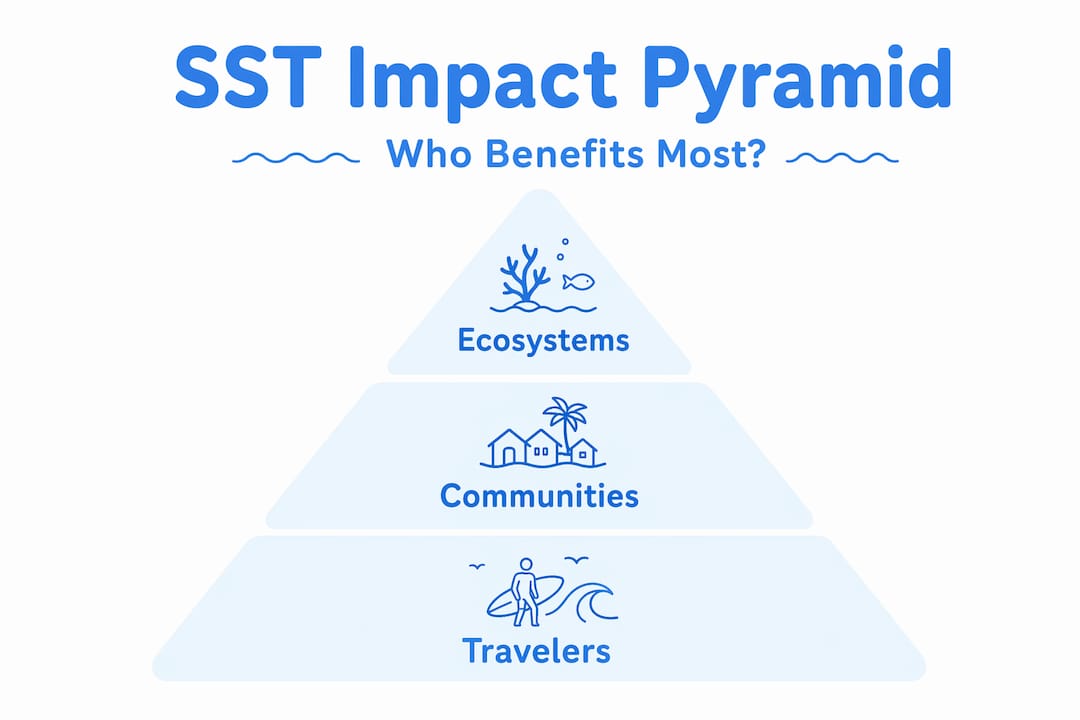
For local communities, SST creates stewardship roles that generate income without displacing people or eroding culture. When locals lead site management and act as guides, interpreters, and rule-enforcers, they gain both economic stability and a reason to protect the resource long-term. This is community-centered management in action. It creates more meaningful experiences for visitors and more sustainable livelihoods for residents.
For ecosystems, the benefits show up in reef health, water quality, and coastal biodiversity when visitor management systems actually work. Plastic bans reduce marine debris. Visitor caps prevent reef damage from anchor drag and foot traffic. Low-impact infrastructure means less runoff and less habitat destruction during construction.
For travelers, the quality of the experience directly shapes the sustainability of the destination over time. Research on socio-cognitive patterns in surf tourism shows that tourists who reframe challenging experiences (a crowded lineup, rain, a flat spell) through social and cultural engagement are more likely to return and invest in the destination. This matters because loyal, repeat visitors fund conservation infrastructure in ways that one-time mass tourism crowds never do.
Eco-friendly surf travel, done right, also preserves surf culture itself. Crowds, pollution, and over-commercialization don’t just harm reefs. They destroy the vibe that made a place worth visiting in the first place. SST protects the intangible qualities of a surf destination just as much as the physical ones. That includes the lineup etiquette, the local knowledge passed between surfers, and the unhurried pace of life in small coastal communities.
My honest take on where SST is headed
I’ve watched surf tourism transform coastal communities over more than two decades, and I’ll be direct: the gap between what operators market as “sustainable” and what actually qualifies is still enormous.
What I’ve found is that the most credible SST operations share one thing. They don’t lead with sustainability as a marketing angle. They lead with community. When a camp’s first conversation is about how many local families it employs or which reef it protects, that’s the real signal. The eco-badge comes later, almost as an afterthought.
My concern is that certification programs, as valuable as they are, risk becoming a checkbox exercise for operators who can afford the application fee. The Sorsogon model interests me precisely because the sustainability there is enforced by economic necessity and community pride, not external validation. Community enforcement mechanisms create accountability that no certification body can replicate.
For travelers reading this: the most powerful thing you can do isn’t choosing the right reusable bag. It’s choosing operators where local people hold genuine power over decisions. Ask who manages the site. Ask where profit goes. Ask what happens to the community when the tourist season ends. Those answers will tell you everything about whether a surf holiday is genuinely sustainable or just styled to look that way.
The future of SST depends on more destinations adopting hybrid governance models where community knowledge, legal frameworks, and conservation science work together. As travelers, we vote for that future every time we book.
— Fernando
Surf sustainably with Riparsurfschool in Portugal
If you are looking for a surf experience that takes its local community and coastal environment seriously, Riparsurfschool is worth your attention. Based at Praia Areia Branca near Peniche and Ericeira since 2001, Riparsurfschool operates with locally certified instructors who know this coastline intimately and care about keeping it that way.

Whether you prefer private surf lessons tailored to your level or group sessions that connect you with the surf community, every experience is grounded in respect for the ocean and the small-beach-village culture that makes this stretch of Portugal’s coast special. Facilities are simple, local, and intentional. You can book surf lessons directly online and start planning a surf holiday that puts you in the water the right way. Learn more about what a community-centered surf camp actually feels like before you arrive.
FAQ
What does sustainable surf tourism actually mean?
Sustainable surf tourism, often abbreviated as SST, is an approach to surf travel that actively manages environmental, social, and economic pressures on coastal destinations. A 2026 framework links it directly to UN SDG 14, prioritizing low-impact operations, community involvement, and governance structures.
How can I tell if a surf camp is genuinely sustainable?
Look for specific, enforced behavioral rules like plastic bans and visitor caps rather than vague eco-branding. Genuine sustainability shows up in who owns the operation, who manages it, and whether profits stay in the local community.
Why does governance matter so much in surf tourism?
Governance structures in marine protected areas determine whether conservation goals are actually met. Fragmented management across jurisdictions creates gaps that allow environmental harm even when individual operators try to do the right thing.
Does my experience as a tourist affect destination sustainability?
Yes, directly. Research shows that tourist experience quality shapes repeat visit intentions, which drives ongoing investment in conservation infrastructure. Loyal visitors who engage with local culture fund the systems that protect reefs and communities long-term.
What is the role of certification in responsible surf tourism?
Certification programs like Ecotourism Australia’s set measurable standards and create transparency for travelers. With over 500 certified operators under its ECO program, the model shows how third-party verification can connect tourism economics with conservation goals in a way that individual promises cannot.
Recommended
Comments