

Why Connect with Nature Surfing for Mental Health


TL;DR:
Surf therapy offers significant mental health benefits by combining physical activity, sensory immersion, and social connection. It fosters mindfulness, reduces symptoms of depression and anxiety, and enhances physical fitness through engaging with the ocean. Safe progression and consistent practice are essential to unlocking surfing’s full healing potential.
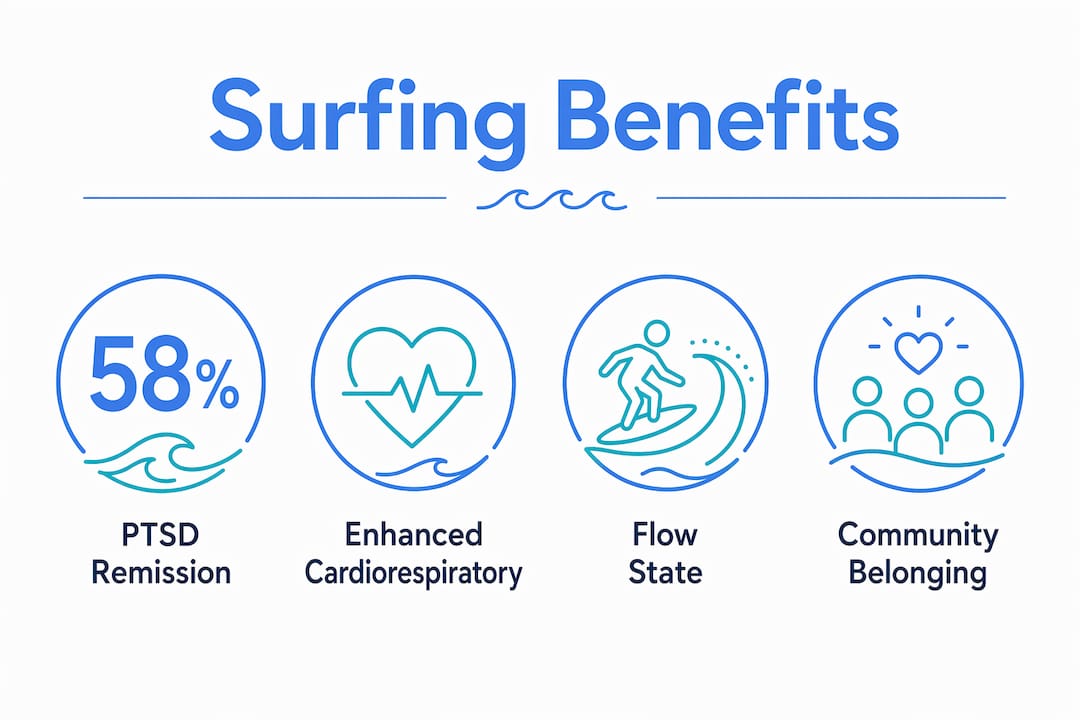
Surfing is defined as one of the most complete forms of nature therapy available, combining physical exercise, sensory immersion in the ocean, and deep social belonging into a single practice. Research confirms that surf therapy produces remission in 58% of veterans with PTSD or Major Depressive Disorder after just six weeks. That number is striking. It means surfing is not a casual wellness trend. It is a clinically observed intervention. The question of why connect with nature surfing goes far beyond recreation. Riparsurfschool has watched this transformation happen firsthand on the beaches of Praia Areia Branca, Portugal, since 2001.
What are the mental and physical health benefits of connecting with nature through surfing?
Surfing delivers benefits across three distinct dimensions: physical, psychological, and social. Each one reinforces the others, creating a feedback loop that other outdoor activities rarely match.
Physical benefits
Surf therapy enhances cardiorespiratory fitness, muscular strength, and flexibility across diverse youth populations. These are not minor gains. Paddling out against Atlantic swells builds shoulder and back strength faster than most gym programs. The constant balance adjustments on a board activate stabilizer muscles throughout the core and legs. Flexibility improves because surfing demands full-body movement in unpredictable directions.
Psychological benefits
The mental health and surfing connection is equally well documented. Research confirms that surfing reduces depression, anxiety, and stress in participants across age groups and backgrounds. The mechanism is not mysterious. Wave riding forces the brain into a state of complete present-moment focus, which interrupts the rumination cycles that drive anxiety and depression. Spending time in and near water also activates the parasympathetic nervous system, lowering cortisol and heart rate.

Social benefits
Surfing fosters belonging and presence through both the ocean environment and the surf community. Veterans in clinical programs describe the experience as “surfing with family,” reporting rapid social bonding that clinical settings rarely produce. That sense of shared challenge and shared joy is not incidental. It is a core mechanism of surfing’s healing power.
The nuance worth noting: Recreational surfing also carries environmental stressors, including ocean unpredictability, cold water, and physical fatigue. These stressors are real. But research shows they do not cancel out the benefits. They are part of what makes the experience meaningful.
Key benefits at a glance:
Reduced symptoms of depression, anxiety, and PTSD
Improved cardiorespiratory fitness and muscular strength
Greater emotional regulation and stress tolerance
Stronger sense of social belonging and community
Increased mindfulness and present-moment awareness
How does surfing uniquely connect us with nature compared to other outdoor activities?
Surfing’s relationship with the natural world is multidimensional in a way that hiking, cycling, or trail running cannot replicate. The concept of “Blue Health” captures this precisely.
Blue Health describes how water environments combine movement, sensory immersion, and ecological connection to restore nervous system function. The ocean is not a backdrop. It is an active participant in the experience. Salt air, wave sound, water temperature, and the physical sensation of being moved by water all engage the senses simultaneously. No other outdoor activity delivers that full-spectrum sensory input.
Hiking offers presence in nature, but the terrain is largely predictable. Cycling demands focus, but the environment stays at a distance. Surfing places you inside the natural system. You are not observing the ocean. You are negotiating with it in real time.
Surfing creates enforced mindfulness, leaving no mental capacity for rumination and producing a rare flow state that is genuinely beneficial for mental health. The wave does not wait for you to finish your thought. It demands everything you have, right now.
This enforced presence is what separates surfing from passive nature exposure. Wave riding induces a flow state that clinical psychologists recognize as one of the most restorative psychological conditions a person can experience. Flow states reduce self-referential thinking, lower anxiety, and produce a sense of effortless competence.
Kelly Slater, widely regarded as the greatest competitive surfer in history, describes surfing as a practice of presence and humility. He frames the ocean as both a mirror and a form of medicine. That philosophical framing aligns precisely with what the research shows.
Pro Tip: If you are new to outdoor activities for mindfulness, start by simply sitting near the water before your first lesson. Let the sound and movement of the ocean recalibrate your nervous system before you ever stand on a board.
The importance of nature in sports is well established, but surfing takes it further. The ocean is never the same twice. Every session is a new conversation with a living, dynamic system. That novelty keeps the brain engaged and prevents the adaptation that makes other forms of exercise feel routine over time.
Activities like sailing trips share some of this sensory richness, placing participants inside a natural environment rather than alongside it. But surfing adds the physical demand of wave riding, which pushes the experience into a different category entirely.
What are the challenges and nuances of connecting with nature through surfing?
Surfing is not a risk-free activity, and treating it as one is both inaccurate and dangerous. A balanced view of nature therapy through surfing requires acknowledging the real challenges involved.
The ocean is genuinely unpredictable. Rip currents, shifting tides, and sudden weather changes create conditions that demand respect and preparation. Surf accidents happen, and they happen more often to people who overestimate their ability or underestimate the water. This is not a reason to avoid surfing. It is a reason to approach it correctly.
Surfing requires progression in knowledge, technique, and fitness to safely access the mental states that make it so beneficial. You cannot skip the fundamentals and expect to experience flow. The gap between where you are and what the ocean demands must be bridged through deliberate skill development.
Here is a practical progression framework for beginners:
Start with certified instruction. A qualified surf instructor teaches you to read waves, understand rip currents, and fall safely before you ever attempt to stand.
Build ocean awareness before wave riding. Spend time in the water without a board. Learn how currents move and how waves break at your local spot.
Develop physical conditioning alongside technique. Paddling strength, core stability, and breath control all need attention before you progress to bigger waves.
Practice wipeout recovery deliberately. Wipeouts teach humility and psychological growth in ways that no other sport replicates. Learning to fall well, stay calm underwater, and surface with composure builds mental resilience directly.
Progress gradually and honestly. The ocean will tell you when you are ready for the next level. Ego-driven progression is the primary cause of surf injuries.
The psychological demands are equally real. Managing fear in the water is a skill that takes time to develop. Surfers who stick with the process report that this fear management transfers directly into everyday life. The humility the ocean teaches is not a side effect. It is a core benefit.
Pro Tip: Before paddling out, spend five minutes watching the water from the beach. Identify where waves are breaking, where rip currents are running, and where other surfers are positioned. This habit builds ocean literacy faster than any lesson.
How can you start connecting with nature through surfing to improve well-being?
Getting started with surfing as a mindfulness and well-being practice is straightforward when you approach it with the right framework. The goal at the beginning is not performance. It is progressive immersion in a natural system that will teach you more than you expect.
Practical starting points for new surfers:
Book guided lessons with certified instructors. Professional instruction compresses the learning curve and keeps you safe. Riparsurfschool’s team at Praia Areia Branca has been guiding beginners since 2001, with local knowledge of the Atlantic that no online tutorial can replicate.
Integrate breath-work into your practice. Controlled breathing before paddling out reduces anxiety and improves underwater composure. Box breathing (four counts in, four counts hold, four counts out, four counts hold) is a proven technique used by competitive surfers and clinical surf therapy programs alike.
Learn basic surf terminology and ocean etiquette. Understanding terms like “right of way,” “drop-in,” and “set wave” keeps you safe and helps you integrate into the surf community faster.
Treat every session as practice, not performance. The surfers who progress fastest are those who stay curious rather than competitive. Each wave is information, not a test.
Connect with the local surf community. Meeting local surfers accelerates learning and provides the social belonging that research identifies as a core mechanism of surfing’s mental health benefits.
The benefits of nature and surfing compound over time. The first few sessions build basic competence. The next few sessions build ocean awareness. After that, the flow states and deep nature connection that the research describes become accessible. Patience is not optional. It is the practice.
Surf retreats offer an accelerated version of this process by combining daily lessons, community, and full immersion in a coastal environment. For people who want to experience the mental health benefits of surfing quickly and safely, a structured retreat is the most direct path.
Key Takeaways
Surfing is the most complete form of nature therapy available, combining physical conditioning, enforced mindfulness, and social belonging into a single practice with clinically documented mental health outcomes.
Point | Details |
Clinical mental health outcomes | 58% of veterans with PTSD or MDD achieved remission after six weeks of surf therapy. |
Blue Health and sensory immersion | The ocean engages all senses simultaneously, restoring nervous system function in ways passive nature exposure cannot. |
Flow state and mindfulness | Wave riding creates enforced present-moment focus, eliminating rumination and producing measurable psychological relief. |
Progression is non-negotiable | Safe, meaningful ocean connection requires deliberate skill development in technique, fitness, and ocean awareness. |
Social belonging accelerates healing | Surf communities create rapid social bonding that amplifies the individual mental health benefits of ocean exposure. |
What surfing in the Atlantic taught me about mental resilience
I have watched hundreds of people walk down to the beach at Praia Areia Branca nervous, skeptical, and carrying stress they could not name. Most of them paddle back in looking different. Not because they caught a perfect wave. Because the ocean asked something of them and they answered.
The conventional wisdom about nature and mental health focuses on passive exposure: walk in a forest, sit by a river, breathe fresh air. Surfing is the opposite of passive. The ocean does not let you spectate. It demands your full attention, your physical effort, and your willingness to be humbled. That demand is the medicine.
What I have found, after years of teaching and surfing, is that the people who benefit most are not the ones who progress fastest. They are the ones who stay curious the longest. The surfer who still marvels at a clean two-foot wave after two years of practice is getting more from the ocean than the one chasing bigger breaks for ego.
Surf therapy is not a replacement for clinical mental health care. It is a powerful complement to it. The research from the Jimmy Miller Memorial Foundation and clinical programs confirms what experienced surfers have always known: the ocean changes you if you let it. The key is showing up consistently, progressing honestly, and treating every session as a conversation with something larger than yourself.
If you are considering surfing as a path to better mental health, start small, start safe, and stay open. The Atlantic will do the rest.
— Fernando
Riparsurfschool: where nature connection begins
Riparsurfschool has been guiding surfers at Praia Areia Branca, near Peniche and Ericeira, since 2001. The location sits at the center of Portugal’s finest Atlantic surf, giving every student direct access to the ocean conditions that make the mental health and nature connection benefits of surfing real and immediate.

Whether you are a complete beginner or returning to the water after years away, Riparsurfschool’s certified local instructors build your sessions around safe progression and genuine ocean awareness. Group surf lessons combine the social belonging that research identifies as a core healing mechanism with expert technical guidance. For a more personal approach, private surf lessons let you move at your own pace. You can also book a surf camp for a full immersive experience that combines daily surfing, community, and life at the edge of the Atlantic.
FAQ
What is surf therapy and how does it work?
Surf therapy is a structured intervention that uses surfing and ocean exposure to improve mental and physical health outcomes. It combines physical activity, sensory immersion, and social connection to reduce symptoms of depression, anxiety, and PTSD.
How does surfing improve mental health?
Surfing induces a flow state that eliminates rumination and forces present-moment awareness, which directly reduces anxiety and depression. The social community around surfing also builds belonging, a key factor in long-term mental well-being.
Is surfing safe for beginners with no ocean experience?
Surfing is safe for beginners when they start with certified instruction and learn ocean awareness before attempting wave riding. Riparsurfschool’s beginner programs at Praia Areia Branca are specifically designed to build safety skills alongside surfing technique.
What is Blue Health and why does it matter for surfers?
Blue Health is the concept that water environments restore nervous system function through combined movement, sensory immersion, and ecological connection. Surfing delivers all three simultaneously, making it one of the most complete Blue Health practices available.
How long does it take to experience mental health benefits from surfing?
Clinical research shows meaningful symptom reduction in as little as six weeks of regular surf therapy sessions. Recreational surfers typically report improved mood, reduced stress, and greater emotional regulation within the first few sessions.
Recommended
Comments