

1.5–2h Surf Lesson Duration in Portugal, Time in Water Wins

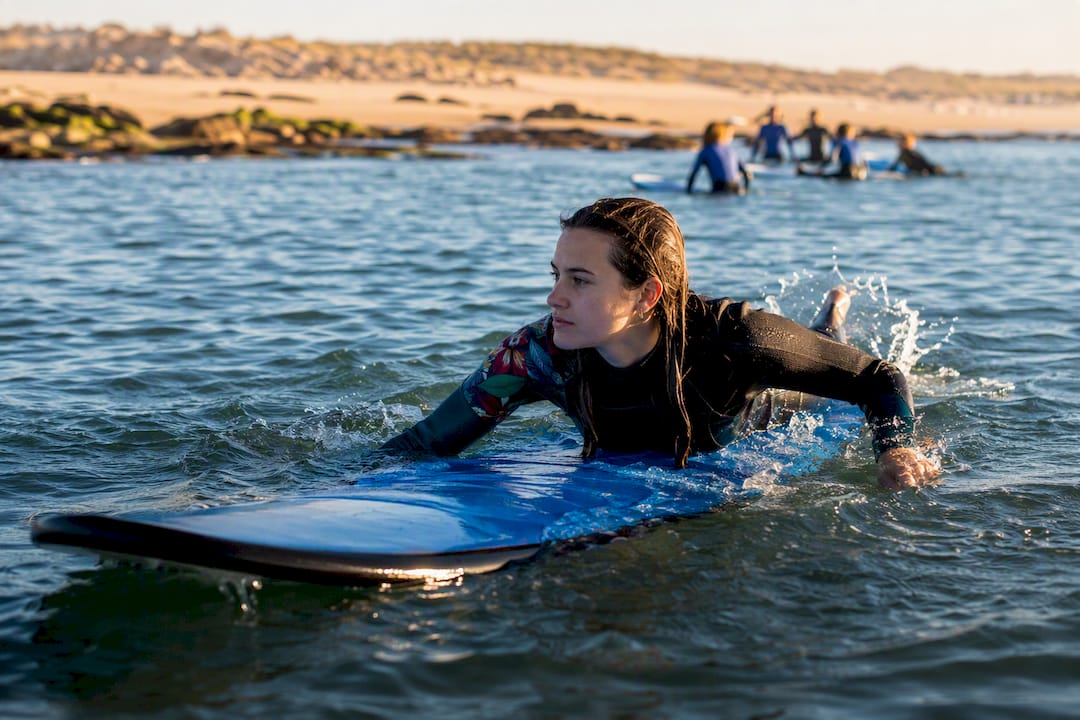
Most beginner and intermediate surf lessons run about 1h30 to 2h, but the clock isn’t what actually teaches you to surf. What matters is how many of those minutes you spend paddling and standing, not sitting on sand or waiting your turn. Before booking, ask two questions: how much time will I actually spend in the water, and what’s the instructor-to-student ratio?
TL;DR:
The actual learning benefit depends on minutes spent paddling and riding waves, not just the scheduled lesson duration.
Smaller student-to-instructor ratios and active water rotation improve the number of usable water minutes per student.
Multi-day surf camps provide significantly more muscle memory and skill retention by stacking sessions across several days.
Lesson quality hinges on water time and supervision rather than group size or lesson length alone.
Confirm policies on weather-related rescheduling and included gear before booking to avoid unexpected costs or delays.
Table of Contents
Duração aula de surf: what the typical time range actually covers
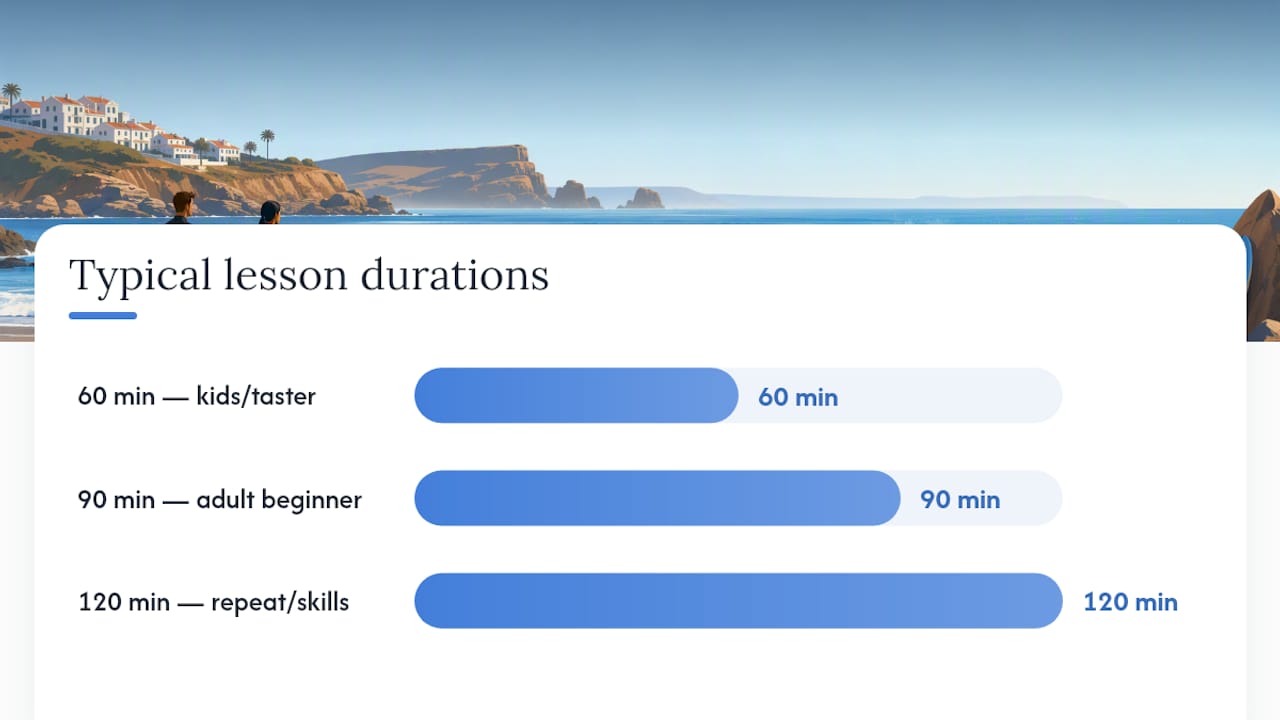
Ask ten schools about duração aula de surf and you’ll get answers clustered around three numbers: 60, 90, and 120 minutes. Each one buys you something different, and the packaging matters as much as the number.
A 60 minute session is usually a taster or a kids’ slot. It’s enough to get someone standing on a longboard in whitewater once or twice, but there’s little room for correction or repetition. A lesson of about one and a half hours is the industry’s sweet spot for most adult beginners and intermediates. It leaves enough runway for a real briefing, a warm-up, and a solid block of wave time without burning out muscles that aren’t used to paddling. A longer lesson usually adds either a second skill focus (turning, reading the lineup) or simply more water time for someone who’s already caught the basics and wants volume.
In Portugal, beginner and intermediate lessons typically run between 1h30 and 2h, a window that includes sand theory, warm-up, the water session itself, and a closing stretch.
What each format commonly includes:
60 minutes: brief safety talk, one or two guided wave attempts, minimal theory.
90 minutes: full briefing, warm-up, extended rotation in the water, short debrief.
120 minutes: everything in the 90 minute format plus more repetitions or a second technique block.
Multi-day camps: five to seven sessions stacked across a week, building total instruction hours far beyond any single booking.
Camps solve a real problem: a single 90 minute lesson barely builds muscle memory. Stack five of them across a week and the muscle memory compounds, which is a large part of why camp formats consistently outperform one-off bookings for actual skill retention.
What really determines how much you learn in the water
The advertised length on a website is a scheduling number. The number that predicts your progress is time in water, meaning the actual minutes you spend paddling, waiting for a wave, or riding one, as opposed to standing on the beach listening to instructions.
Ratio is the other lever. Recommended student-to-instructor ratios for beginners sit around 1:6 to 1:8, ideally with a second helper positioned in the water rather than watching from shore. A class of twelve with one instructor on the beach and nobody in the lineup will always deliver fewer usable minutes per student than a smaller group with someone physically pushing you into waves.
Rotation systems decide how those minutes get split. In a well-run class, the instructor cycles students through the takeoff zone so nobody sits idle for ten minutes waiting a turn. In a poorly run one, the fastest or most confident students hog the good sets while everyone else treads water.
Ask how many students are typically in the water at once per instructor.
Ask whether there’s a second person helping with pushes and positioning.
Ask what a “wave count” or minutes-in-water target looks like for a typical session.
Pro Tip: Ask the school directly what their target number of waves per student is for a typical lesson. A school that can answer with a specific figure is usually running a tighter rotation than one that gives a vague “as many as possible.”
Sample 90-minute lesson: minute-by-minute breakdown
A well-structured 90 minute session follows a predictable rhythm. Schools that skip steps or rush through them are usually cutting corners on your actual learning time, not just the schedule.
0 to 15 minutes: safety briefing on the beach, covering hazards, hand signals, and basic beach orientation.
15 to 25 minutes: dry-land warm-up and pop-up practice on the sand, rehearsing the exact motion you’ll need in the water.
25 to 80 minutes: the core block. Paddle out, rotation through the lineup, coached wave attempts, and repeated feedback.
80 to 90 minutes: debrief on the beach, quick stretching, and individual feedback on what to work on next time.
That’s 90 minutes of instructional content, but rarely 90 minutes of total time on site. Many Portuguese schools note that suiting up, distributing boards, and walking to the teaching zone push actual on-site time to considerably longer than the advertised lesson length, even when the lesson itself is billed at 90 minutes. That gap isn’t a red flag on its own. It’s just logistics, and it’s worth planning your day around the two-hour figure rather than the advertised one.
How lesson format changes duration and value
Group, private, and kids’ lessons aren’t just different prices. They’re different trade-offs between social experience, cost, and raw minutes in the water.
Group lessons (commonly six to eight students per instructor) cost less per person and offer a social, camp-like atmosphere, but each student gets a smaller slice of coached attention.
Private and semi-private lessons compress the same or more water time into fewer students, which usually means faster correction of bad habits and quicker progress.
Multi-day camps stack several sessions across a week, which builds far more cumulative water time than any single booking, group or private.
If your goal is fast, visible improvement in a short trip, private or semi-private lessons are worth the extra cost. If you’re relaxed about pace and want the social side of learning alongside other beginners, group lessons remain the better value per dollar spent.
What’s usually included and what to bring
Most lesson prices bundle the board, wetsuit, leash, and basic accident insurance, so you rarely need to own gear before your first session. Group lessons running 1.5 to 2 hours in Portugal typically cost between €15 and €60, depending on location, group size, and what’s bundled in.
Typically included:
Surfboard sized to your height and skill level.
Wetsuit and leash.
Basic accident insurance (confirm coverage details before booking).
Local transport to the beach, when specified by the school.
Bring yourself:
Swimsuit worn under the wetsuit.
Towel, sunscreen, and water (see this beach packing checklist for essentials).
ID and a payment method.
Before booking, confirm board and wetsuit sizing, exactly what the insurance covers, the meeting point, and what happens if conditions turn bad on the day. A school that can’t answer those clearly on the phone or by email is one to reconsider.
Why trust this guidance: a practical perspective on lesson standards
This guidance comes from Fernando, drawing on how Ripar Surf School structures its own lessons in Praia Areia Branca, near Peniche and Ericeira.
Ripar’s operational choices track closely with what this article recommends:
Small group sizes designed to keep the instructor-to-student ratio tight rather than maximizing headcount per session.
Board, wetsuit, and accident insurance included in the lesson price, with sizing confirmed before you paddle out.
Certified local instructors who know the sandbanks and swell patterns of the surrounding beaches.
Online booking with real-time availability, so you can check dates before committing to travel.
Cancellation and rescheduling: how timing policies actually work
Weather and swell size change fast on the Portuguese coast, and lesson timing policies exist mainly to handle that unpredictability. Most schools build flexibility into their booking terms rather than locking you into a fixed slot no matter what the ocean does.
A typical policy lets you reschedule, at no cost, when conditions on the day are unsafe for beginners. Big swell, strong wind, or dangerous currents are the usual triggers, and a responsible school will call this before you show up rather than after you’re standing on the sand in a wetsuit. Some schools also build in a grace window, commonly 24 to 48 hours, for the student to reschedule for personal reasons without a penalty.
What varies more is the fine print: whether rescheduling is unlimited or capped at once per booking, whether a no-show without notice forfeits the payment, and whether multi-day camp bookings prorate refunds for missed days versus lessons rebooked later in the week.
Before you pay, ask specifically what happens if the surf is flat or dangerous on your booked day, and get the answer in writing if you’re booking a multi-day package. A school that reschedules readily around weather is usually the same school that runs a tight rotation in the water. Both come from the same instinct: protecting your time and money rather than just filling a slot on the calendar.
Book a lesson built around real water time
Riparsurfschool structures its lessons around the same standard this article recommends: small groups, a tight instructor-to-student ratio, and board, wetsuit, and insurance bundled into the price so there’s no scramble at the beach. Lessons run in the 1h30 to 2h window at Praia Areia Branca, with instructors who work the rotation actively rather than watching from the sand.

If you want faster, more individual correction, private and semi-private lessons compress more coached water time into fewer students. Traveling for a longer stretch? A multi-day surf camp stacks sessions across the week, which builds far more cumulative practice than any single booking. Check dates and book a lesson online to see current availability at Praia Areia Branca.
A quick note on what beginners should actually prioritize
Forget the number on the booking page. Ask about ratio, ask about time in water, and ask what happens if the swell is bad on your day. Those three answers tell you more about a lesson than any duration ever will.
Nerves are normal before a first session, so breathe slowly on the paddle out and let the instructor set the pace. Progress in surfing comes from repetition, not from a longer clock. Check the booking page for current dates, and see what past students have said about their sessions.
— Fernando
Sources
Recommended
Comments