

Your First Surf Lesson: What to Expect and How to Prepare

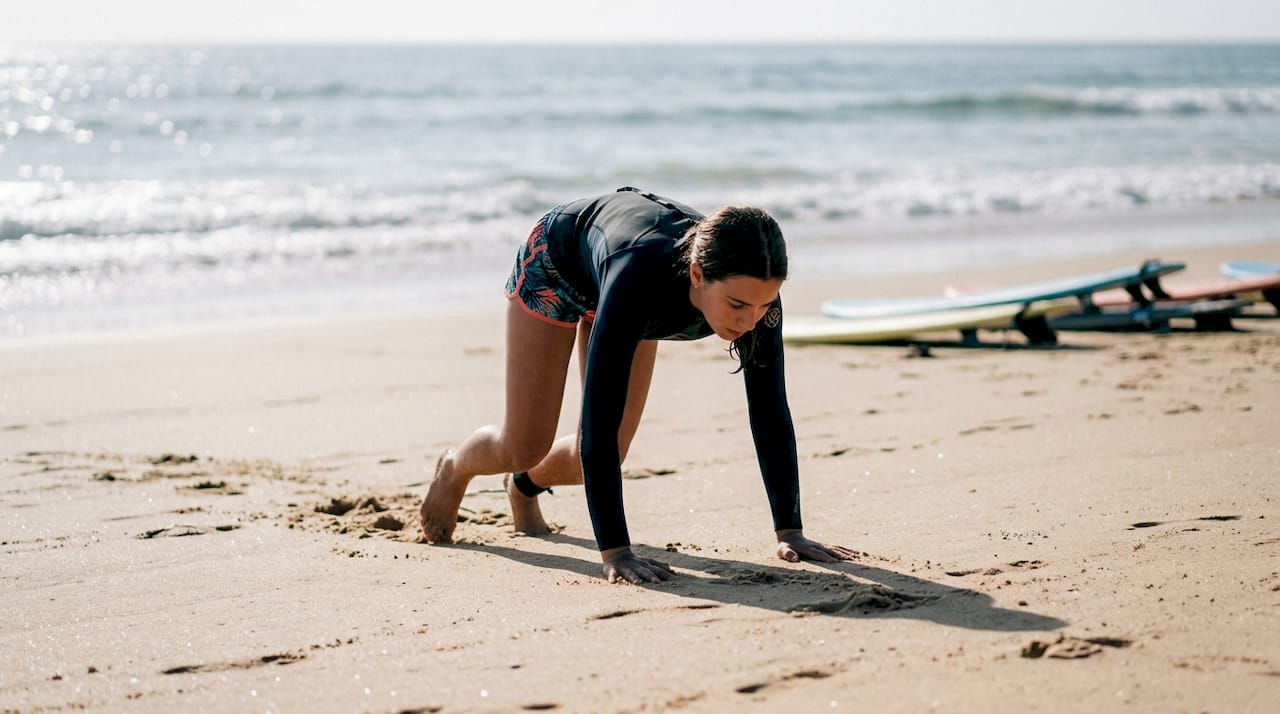
Your first surf lesson, known in Portuguese surf culture as the primeira aula de surf, follows a clear structure: a safety briefing on the beach, pop-up practice on dry sand, then supervised whitewater rides in shallow water. According to Surf Brigade, a session with a certified instructor teaches ocean reading, paddling mechanics, and the pop-up far faster and more safely than self-teaching. Schools like Riparsurfschool pair that structure with ISA (International Surfing Association) certified instructors and small class sizes so you get real feedback from the first minute.
Here is what you will walk away with after that first session:
A working pop-up technique, practiced on sand before you touch the water
Basic paddling mechanics and how to position yourself on the board
At least a few successful rides on broken whitewater waves
A safety briefing covering rip currents, local hazards, and how to exit the water safely
An understanding of which conditions are right for beginners
Pro Tip: Book a school that lists its instructor certifications and student-to-instructor ratio before you arrive. ISA certification is the global benchmark for surf instruction quality.
Key Takeaways
Your first surf lesson covers safety, pop-up mechanics, and supervised whitewater riding, and consistent independent surfing typically requires 10–20 hours of practice across multiple sessions.
Point | Details |
Lesson structure | Safety briefing on sand, pop-up drills, then supervised whitewater rides in a 60–90 minute session. |
Board choice | Use a soft-top foam longboard (8–9 ft) for stability and safer impacts during your first lessons. |
Safety priority | Learn rip-current recognition, surf with lifeguard supervision, and stay in whitewater until your instructor clears you for the outside. |
Realistic timeline | Most beginners stand in session 1 or 2; consistent riding takes 10–20 hours across multiple sessions. |
Riparsurfschool | ISA-certified instructors, small classes, and all gear included at beginner-friendly Praia Areia Branca since 2001. |
Table of Contents
What actually happens in your first surf lesson, step by step
Most beginner surf classes run about an hour and follow a sequence that experienced schools have refined over decades. Here is how it typically breaks down:
Welcome and introductions (5 minutes). Your instructor covers names, experience levels, and any medical considerations. Small classes mean this is quick and personal.
Safety briefing on the sand (10–15 minutes). You learn to spot rip currents, understand the local break, and hear the rules for the session. This is not optional filler. It is the part that keeps you safe.
Equipment demo (5 minutes). The instructor walks you through the board, leash attachment, and how to carry the board safely to the water.
Warm-up on the beach (5–10 minutes). Shoulder circles, hip rotations, and light cardio to prepare the muscles you will use most.
Pop-up practice on land (10–15 minutes). You rehearse the pop-up on your board lying flat on the sand. SurfSpotGuide recommends repeating this multiple times before entering the water to build muscle memory.
Shallow-water whitewater practice (30–40 minutes). The instructor pushes your board into broken waves while you practice paddling, timing, and standing. Most of the session is here.
Debrief (5 minutes). Quick feedback on what worked, what to fix, and what to focus on next time.
Small class sizes change the quality of steps 6 and 7 dramatically. With fewer students, the instructor can watch your pop-up, correct your foot placement, and push you into waves at the right moment rather than managing a crowd.
Pro Tip: During land practice, do at least 10 pop-up reps before entering the water. The movement needs to feel automatic before the ocean adds chaos to the equation.
What gear do you need, and what does the school provide?
Most certified surf schools supply everything a beginner needs. Before booking, confirm the following:
Soft-top foam longboard (8–9 feet). SurfSpotGuide confirms that high-volume soft-tops provide maximum stability and are materially safer on impact than fiberglass boards. This is non-optional for a first lesson.
Leash. Should be at least the length of your board. Keeps the board from becoming a hazard to others after a wipeout.
Wetsuit or rashguard. Depends on water temperature. A wetsuit that is too thin leaves you cold and fatigued within 20 minutes, which kills your ability to focus on technique.
Sunscreen. Reef-safe, water-resistant, applied before you leave the changing room.
Water shoes (optional). Useful if the beach access involves rocks.
Most schools provide soft-top boards, leashes, and wetsuits as part of the lesson package. Ask specifically about wetsuit sizes and whether gear is rinsed between sessions.
Gear item | Typically provided by school | What to check |
Soft-top longboard (8–9 ft) | Yes | Volume appropriate for your weight |
Leash | Yes | Board-length minimum, no fraying |
Wetsuit | Yes | Correct thickness for water temp |
Rashguard | Sometimes | Ask if included or bring your own |
Sunscreen | No | Bring reef-safe, water-resistant SPF |
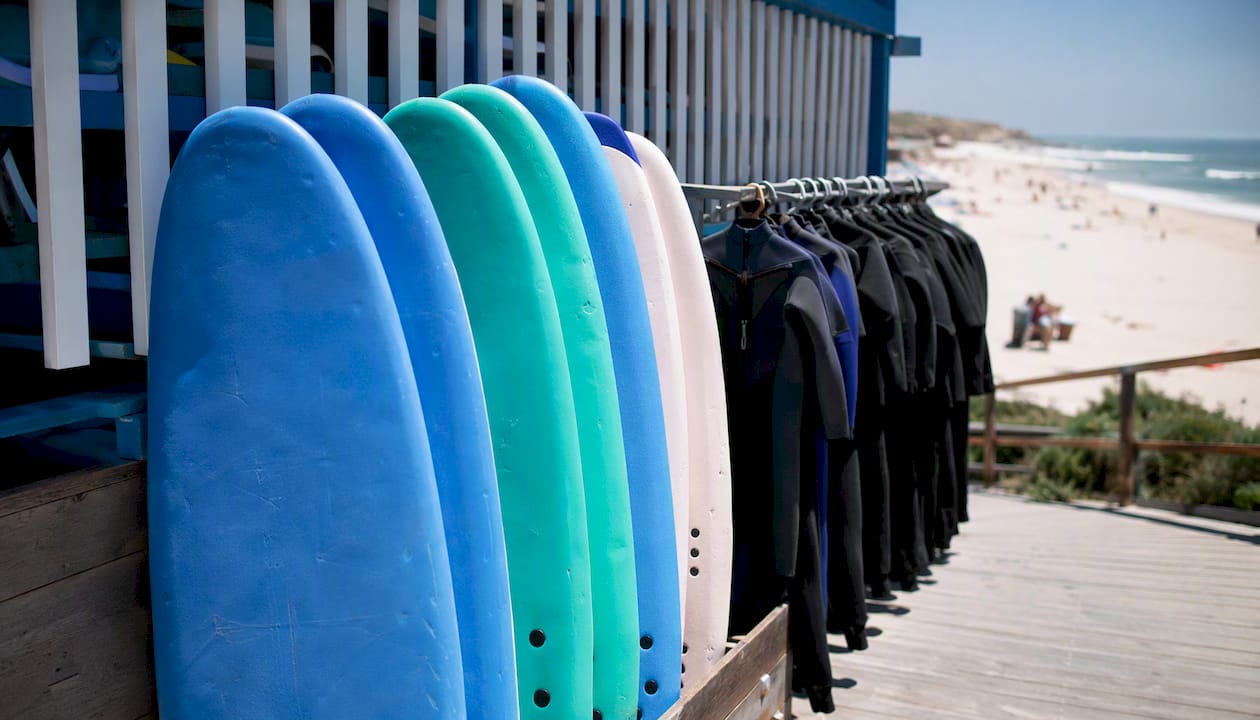
Pro Tip: Ask the school what wetsuit thickness they use. Atlantic water in Portugal runs cool even in summer. The right thickness keeps you warm enough to stay focused on learning rather than on staying warm.
How do you choose the right surf school and instructor?
The difference between a good first lesson and a frustrating one usually comes down to the school, not the ocean. Here is what to look for:
ISA certification or equivalent. The International Surfing Association sets the global standard for instructor qualification. Ask directly whether your instructor holds a current certification.
Student-to-instructor ratio. Aim for no more than 6–8 students per instructor. Smaller groups mean more pushes, more corrections, and more time in the water.
Lifeguard presence or equivalent safety cover. The American Red Cross recommends always surfing in areas with lifeguard supervision, especially as a beginner.
Clear safety protocols. A good school briefs you on rip currents, sets a defined surf zone, and has a clear plan if someone gets into difficulty.
Well-maintained equipment. Soft-tops with deep gouges or wetsuits with broken seams are signs of a school cutting corners.
When booking, ask these four questions: What is the maximum class size? Are instructors ISA-certified? What happens if conditions are unsafe? What is included in the price?
On the private versus group question: group lessons work well for most beginners and cost less. Private lessons make sense if you want to accelerate progress, have specific physical limitations, or simply prefer one-on-one attention. Understanding what makes a surf instructor effective helps you evaluate schools before you commit.
Rip currents, injury prevention, and what the research says
Surfing carries real risk, and most of it is manageable with the right preparation. The American Red Cross is direct: learn to recognize rip currents, surf where lifeguards are present, and stay within your skill level. Rip currents are responsible for the majority of lifeguard rescues at surf beaches. They look like darker, choppier channels of water moving away from shore. If you get caught in one, swim parallel to the beach, not against the current.
Sports medicine guidance from AOSSM makes a related point: most surfing injuries are preventable. The main levers are correct equipment (high-volume boards reduce fatigue-related falls), proper warm-up, and stopping before exhaustion sets in. Tired surfers make poor decisions and absorb impacts badly.
Rip currents: swim parallel to shore to escape, not directly toward it
Board impact: always cover your head with your arms when wiping out
Fatigue: end the session before your arms give out, not after
Leash safety: a board-length leash prevents dangerous rebound after a wipeout
Pro Tip: At the start of every session, ask your instructor where the rip channels are that day and where the safe exit point is. Conditions change with the tide, so yesterday’s answer may not be today’s.
How to prepare physically and mentally before your first lesson
You do not need to be an athlete. You do need to show up warmer, looser, and more hydrated than you think necessary.
The night before: eat a normal meal, sleep well, and avoid alcohol.
Morning of the lesson: eat a light meal 60–90 minutes before. Paddling on a full stomach is uncomfortable.
Hydrate: drink water before you arrive. Salt water and sun dehydrate you faster than you expect.
5-minute warm-up before the lesson: arm circles, hip rotations, a few bodyweight squats, and a plank hold. Outside Online’s beginner guide recommends interval-style conditioning and mobility work to build the endurance and core control that paddling and pop-ups demand.
Practice the pop-up at home: lie face-down on a yoga mat or towel, hands under your chest, and practice jumping to your feet in one smooth motion. Do 10–15 reps the evening before.
On the mental side: expect to fall. A lot. The students who progress fastest are the ones who treat each wipeout as data rather than failure. Commit fully to every pop-up attempt. A half-hearted stand-up is harder to execute than a decisive one, and instructors can spot the hesitation immediately.
Pro Tip: If you feel seasick or disoriented in the water, focus on the horizon and breathe slowly. It passes within a few minutes for most people.
Common beginner mistakes and how to fix them fast
Most first-lesson frustrations trace back to a small number of repeatable errors:
Too far forward on the board. Your weight tips the nose under. Fix: slide back until the tail is just above the waterline when paddling.
Half-committing to the pop-up. You end up on your knees instead of your feet. Fix: practice the full movement on land until it is one explosive motion, not two hesitant ones.
Not paddling early enough. The wave passes under you. Fix: start paddling when the wave is still 6–8 feet behind you, not when it is already lifting the tail.
Rushing to the outside break. Whitewater is where the learning happens. Staying in the broken waves is not a consolation prize. It is the correct training environment, as Surf Brigade confirms.
Looking down at the board. Your body follows your eyes. Fix: pick a point on the beach and look at it when you stand.
Safe wipeout behavior matters too. When you fall, push the board away from you, cover your head with both arms, and surface slowly. Never surface headfirst into an unknown depth.
Pro Tip: Celebrate the small wins. Three clean whitewater rides in a row is a better first session than one dramatic stand-up followed by six failed attempts. Consistency is the goal.
When will you stand, and what does progress look like?
Most beginners stand on their first or second lesson. Consistent, independent riding is a different milestone. SurfSpotGuide estimates that 10–20 hours of practice spread across multiple sessions is the typical range before a beginner rides waves reliably without instructor assistance.
Here is a rough progression map:
Session 1: Pop-up mechanics, first whitewater rides, basic paddling. Many people stand at least once.
Sessions 2–3: More consistent pop-ups, better paddle timing, starting to feel the wave rather than just reacting to it.
Sessions 4–5: Riding whitewater with control, beginning to angle the board slightly, longer rides.
Beyond session 5: Transitioning toward unbroken waves requires a separate skill set. Multi-day surf camps compress this timeline significantly because daily repetition locks in muscle memory faster than weekly lessons.
Lesson duration is typically 60–90 minutes. Group classes usually cap at 6–10 students. If you can manage two sessions per week, or a multi-day camp, you will reach consistent riding noticeably faster than once-a-week lessons allow.
What instructors notice that most beginners never hear
The students who improve fastest are not always the most athletic. They are the ones who listen carefully on the sand and commit fully in the water. That pattern repeats itself across every skill level.
The most common breakthrough moment happens on land, not in the ocean. A small adjustment to foot placement during pop-up practice, or a correction to where the hands push from, produces a completely different result in the water five minutes later. The sand session is not a formality. It is where the lesson actually happens.
At Praia Areia Branca, where Riparsurfschool operates, the beach conditions favor beginners: consistent whitewater, a sandy bottom, and a relatively sheltered bay compared to the exposed breaks at nearby Peniche. That geography matters. A beginner’s first experience in manageable conditions builds confidence that transfers directly to technique.
[Fernando’s certifications and professional qualifications to be inserted here.]
[Testimonials from students about Fernando’s instruction to be inserted here.]
Riparsurfschool gives you the right start at Praia Areia Branca
Riparsurfschool has been running beginner lessons at Praia Areia Branca since 2001, and the setup is built specifically for first-timers: ISA-certified instructors, small class sizes, soft-top boards, leashes, and wetsuits all included. The beach itself is among the most forgiving beginner breaks in Portugal, with consistent whitewater and a sandy bottom that makes wipeouts far less punishing than rocky alternatives.

The choice between a group lesson and a private lesson comes down to what you want from the session. Group lessons are social, affordable, and work well for most first-timers. Private lessons give you the instructor’s full attention for the entire session, which accelerates progress noticeably if you want to move past whitewater quickly. Either way, every session includes the safety briefing, equipment, and instructor support described throughout this article. Check availability and book your first lesson online to secure your spot.
Sources
The safety and equipment guidance in this article draws from the following sources:
For site-specific hazards, always ask your instructor or the local lifeguard for a conditions briefing before entering the water. No online guide replaces local knowledge on the day.
Recommended
Comments