

Learning Surf Terminology List: Beginner's Guide

TL;DR:
Learning surf terminology systematically helps beginners understand gear, ocean conditions, maneuvers, and etiquette more quickly.
Focusing on essential terms like leash, paddle, drop-in, and peak enables safer and more confident surfing experiences.
Surf terminology is the shared language that keeps every surfer safe, informed, and respected in the water. Without it, you miss instructions from your coach, misread ocean conditions, and accidentally break unwritten rules that matter deeply to local surf communities. The best way to build fluency fast is through a categorized surf glossary covering gear, ocean conditions, maneuvers, and surf culture. Boardriders organizes over 100 terms across these four categories, treating surf vocabulary as a progressive language rather than a random list of slang. This guide follows that same structure so you can learn surf words in the order that actually helps you in the water.
1. Learning surf terminology list: why structure matters
Surf terminology explained as a single flat list is hard to retain. Organized by category, the same terms stick immediately because each word connects to a real situation you will face. Structured learning across categories accelerates beginners’ fluency and confidence in the water far faster than memorizing random vocabulary. Think of it the way a traveler learns a foreign language: food words first, then directions, then social phrases. Gear terms come first because you encounter them before you even touch the water.
2. Essential surf gear terms every beginner should know
Gear vocabulary is the first layer of any surfing jargon guide because you hear these words during equipment rental, board selection, and your very first lesson. Knowing them prevents confusion and helps you ask the right questions.
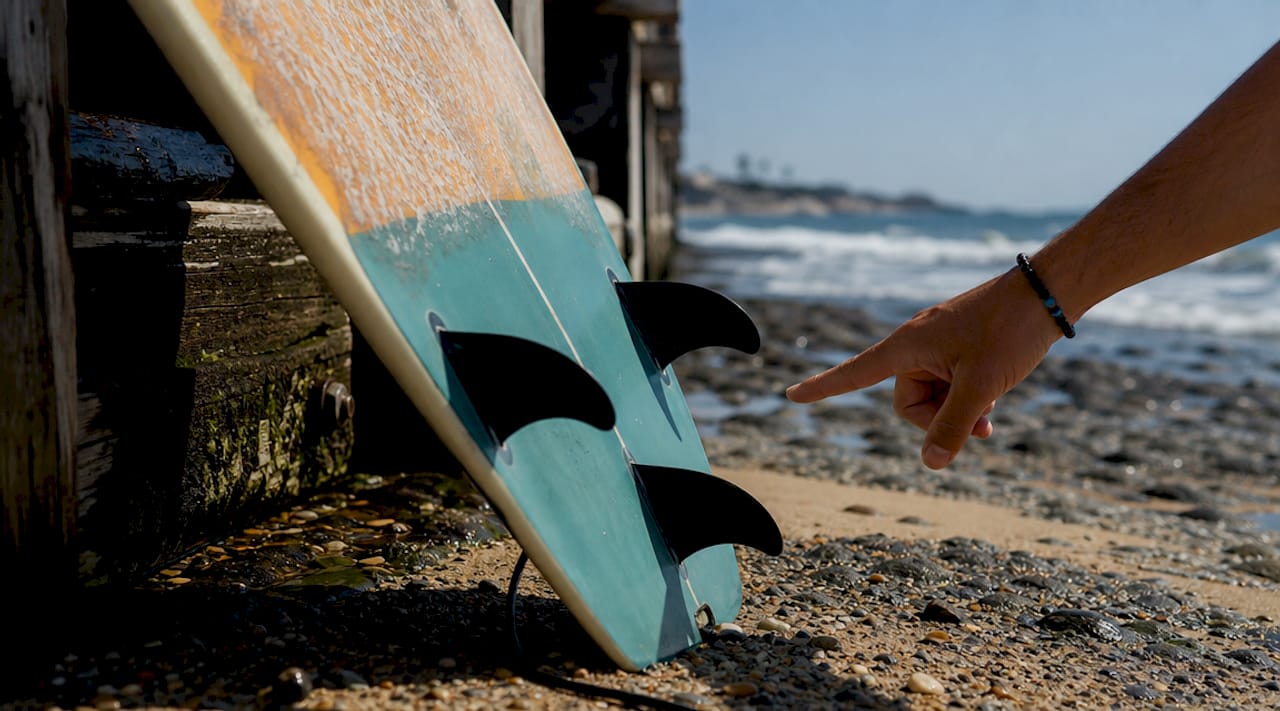
The leash, wax, and fins are the three most critical gear terms for any beginner. The leash is the cord that attaches your ankle to the tail of the board, keeping it from washing away after a wipeout. Wax is applied to the deck (the top surface of the board) to create grip for your feet. Fins are the blade-like structures on the underside of the tail that stabilize the board and allow you to steer.
Here are the core gear terms you need before your first session:
Deck: The top surface of the board where you stand
Rails: The edges running along both sides of the board
Nose: The front tip of the board
Tail: The back end of the board where the leash attaches
Quiver: A surfer’s personal collection of boards for different conditions
Fins: Stabilizing blades under the tail
Leash: The cord connecting your ankle to the board
Wax: Grip coating applied to the deck
Check out Riparsurfschool’s surf equipment guide for a detailed breakdown of board parts and beginner-friendly gear choices in Portugal.
Pro Tip: When renting a board in Portugal, ask specifically for a longboard or foam board (also called a “foamie”) if you are a first-timer. Knowing the gear vocabulary lets you have that conversation confidently instead of just pointing at the rack.
3. Common ocean and wave terms to read surf conditions
Reading the ocean is a skill, and the vocabulary is the foundation. Without these terms, a surf instructor’s pre-session briefing sounds like a foreign language. With them, you understand exactly what to expect before you paddle out.
Ocean terms like barrel, beach break, reef break, and whitewater describe wave types and conditions that directly affect where you surf and how you position yourself. A beach break is a wave that breaks over a sandy bottom, making it the safest and most forgiving option for beginners. A reef break breaks over rock or coral and demands more experience. The barrel (also called the tube) is the hollow cylinder formed when a wave curls over itself. Whitewater is the foamy, broken wave that beginners practice on before moving to unbroken green waves.
Wind direction changes everything about wave quality. Offshore wind blows from land to sea and smooths wave faces, creating cleaner, more defined surf. Onshore wind blows from sea to land and chops up the surface, making waves messy and harder to ride. Instructors use these terms not as synonyms for good or bad weather but to indicate wave quality that affects your board setup and timing.
Term | Definition | Why it matters for beginners |
Barrel | Hollow tube formed by a breaking wave | The iconic surf goal; beginners learn to recognize it first |
Beach break | Wave breaking over sand | Safest wave type for learning |
Reef break | Wave breaking over rock or coral | Requires experience; avoid as a beginner |
Whitewater | Broken, foamy wave after it has crashed | Where beginners start practicing pop-ups |
Crest | The top of a wave | Helps you time your take-off |
Shoulder | The unbroken section beside the breaking part | Where beginners ride to avoid the power zone |
Channel | Deep water beside the break | The safe paddling lane back to the lineup |
Pro Tip: Before every session at Praia Areia Branca, scan the ocean for the channel. It is almost always calmer and darker blue than the breaking zone. Paddling out through the channel instead of fighting whitewater saves enormous energy.
4. Basic surf maneuver vocabulary for beginners
Action verbs are the most practical part of any glossary of surfing terms. Learning action verbs like paddle and duck dive helps beginners anticipate moves and gain confidence faster than memorizing nouns alone. When your instructor shouts “pop up!” you need to know exactly what your body should do.
Here are the foundational maneuver terms taught in beginner lessons:
Paddle: The arm-stroking motion used to propel yourself through the water and catch waves
Duck dive: The technique of pushing the nose of the board underwater to pass beneath a breaking wave
Take-off: The moment you commit to a wave and begin to stand
Pop-up: The explosive movement from lying flat to standing on the board in one motion
Bottom turn: The first turn at the base of the wave after the take-off, which sets up every subsequent move
Cutback: A turn back toward the breaking part of the wave to maintain speed
Wipeout: Falling off the board, intentionally or not
Paddle and duck dive are the two foundational beginner maneuvers taught in the first lesson because they determine whether you reach the lineup at all. The pop-up is the single most practiced movement on dry land before any beginner enters the water. The bottom turn is often overlooked by new surfers, but every experienced surfer will tell you it is the move that makes all other moves possible.
5. Surf lineup etiquette and culture terms every beginner must know
Surf etiquette is not optional. Breaking these unwritten rules creates real conflict and genuine danger. Understanding the vocabulary behind the rules is the first step to behaving correctly in any surf spot around the world.
The lineup, peak, channel, and priority form a linked system that governs every surf session. The lineup is the zone where surfers sit and wait for waves. The peak is the highest point where the wave first breaks, and it is where priority is established. The channel is the calmer water beside the break used for paddling out safely.
Here are the key etiquette terms in order of importance:
Priority: The right to catch a wave without interference. The surfer closest to the peak holds priority.
Dropping in: Paddling for a wave that another surfer already has priority on. Dropping in is the most serious violation of surf etiquette and causes the majority of lineup conflicts.
Snaking: Repeatedly paddling around another surfer to steal their position and priority. Locals notice this immediately.
Right of way: The formal principle that the surfer deepest (closest to the peak) on a wave has the right to ride it unobstructed.
Calling your direction: Shouting “left!” or “right!” as you take off to signal which way you are going, helping other surfers avoid you.
Localism: The informal territorial behavior of regular surfers at a specific break. Respecting locals by waiting your turn and not overcrowding the peak is non-negotiable.
Kook: Slang for a beginner who does not yet understand etiquette. Nobody wants this label. Learning these terms removes it.
Many newcomers misunderstand surf etiquette, but anchoring priority on proximity to the peak and looking over your shoulder before taking off prevents most disputes. For a deeper look at surf culture and social rules, Riparsurfschool’s guide to surfing traditions and culture covers the full social context behind these terms.
Key takeaways
Mastering surf terminology requires learning gear, ocean, maneuver, and etiquette terms in that order because each category builds directly on the last.
Point | Details |
Start with gear terms | Knowing leash, fins, deck, and wax prepares you for equipment rental and your first lesson. |
Read the ocean with wave vocabulary | Terms like offshore wind, beach break, and channel directly affect where and how safely you surf. |
Learn action verbs first | Paddle, duck dive, and pop-up are the moves instructors call out most; knowing them speeds up your progress. |
Respect the lineup system | Priority, dropping in, and right of way are safety rules, not just social preferences. |
Use a structured glossary | Boardriders’ 100-term glossary organized by category is the most reliable reference for building surf vocabulary progressively. |
Why I think most beginners learn surf terms in the wrong order
I have been teaching surfing at Praia Areia Branca since the early 2000s, and the pattern I see most often is this: beginners try to memorize cool-sounding words like “barrel” and “cutback” before they know what a leash or a channel is. That is backwards. The barrel is a goal. The channel is a survival tool. You need the survival tools first.
The students who progress fastest are the ones who treat surf vocabulary the way a pilot treats pre-flight checklists. Gear first, then ocean reading, then movement, then social rules. When you know what offshore wind means before you paddle out, you make better decisions about timing. When you know what the channel is, you stop fighting the ocean on the way out. When you know what dropping in means, you avoid the one mistake that gets beginners yelled at in every surf spot on earth.
My honest advice: spend 20 minutes with a structured surf terminology guide the night before your first lesson. You will absorb instruction twice as fast because your brain already has the hooks to hang new information on. The water teaches everything else.
— Fernando
Start learning surf terms in the water with Riparsurfschool

Reading about surf terminology is a strong start. Applying it in real waves with a certified instructor is where the vocabulary becomes instinct. Riparsurfschool has been running surf lessons and surf camps at Praia Areia Branca, near Peniche and Ericeira, since 2001. Every lesson integrates terminology coaching so you leave the water knowing not just what you did, but what to call it. Whether you prefer a group surf lesson with other beginners or a private surf lesson focused entirely on your pace, the instructors here speak your language from day one. Book your session online and show up ready to surf.
FAQ
What does surf terminology mean?
Surf terminology refers to the specialized vocabulary surfers use to describe equipment, ocean conditions, maneuvers, and lineup behavior. Knowing these terms improves safety, communication with instructors, and respect within the surf community.
What are the most important surf terms for beginners?
The most critical beginner surf words are leash, paddle, pop-up, lineup, peak, and offshore wind. These terms cover the gear you use, the moves you practice, and the ocean environment you read before every session.
What is dropping in, and why does it matter?
Dropping in means paddling for a wave that another surfer already has priority on. It is the most serious etiquette violation in surfing and causes the majority of conflicts and collisions in the lineup.
How many surf terms should a beginner learn first?
Focus on 20 to 30 terms across the four main categories: gear, ocean conditions, maneuvers, and etiquette. Boardriders’ glossary of surfing terms covers over 100 words, but a working vocabulary of 25 to 30 terms is enough to function confidently in lessons and at the beach.
What is the difference between a beach break and a reef break?
A beach break is a wave that breaks over a sandy bottom and is the safest option for beginners. A reef break breaks over rock or coral, produces more powerful and predictable waves, and requires significantly more experience to surf safely.
Recommended
Comments