

Surf Terminology for Beginners: Your Essential Guide

TL;DR:
Learning surf terminology helps beginners understand safety, etiquette, and improve communication in the water. It enables quick comprehension of instructions, proper decision-making, and respectful interactions with other surfers. Mastering these terms accelerates progress and fosters confidence during early surf experiences.
You paddle out for the first time, someone yells “drop-in!” and points at you with a look you can’t quite read. Another surfer tells you to “stay out of the impact zone.” You nod and smile, having no idea what either phrase means. Learning surf terminology for beginners isn’t just about fitting in. It’s about staying safe, understanding your instructor, and earning respect in the water before you’ve even caught your first real wave.
Table of Contents
Key takeaways
Point | Details |
Gear terms matter early | Knowing board parts like nose, tail, fins, and rails helps you understand lessons and choose equipment. |
Wave types affect safety | Beach breaks are the safest option for beginners; knowing break types helps you choose the right spot. |
Etiquette is not optional | Priority rules and drop-in awareness keep the lineup safe and keep you from looking like a kook. |
Stance is personal, not skill | Regular (left foot forward) and goofy (right foot forward) are equal in terms of ability and progression. |
Lingo accelerates progress | Beginners who embrace surf lingo and etiquette tend to progress faster and gain acceptance in surf communities. |
Surf terminology for beginners: gear and board basics
Every sport has its gear vocabulary, and surfing has a lot of it. Getting familiar with basic surfing terms for equipment will make your first lesson dramatically less confusing.
Start with the board itself. The nose is the front tip, and the tail is the back end. The rails are the sides of the board that cut through the water. Running down the center of most boards is the stringer, a thin strip of wood that adds rigidity. The leash is the cord that connects your ankle to the board so it doesn’t fly into someone’s face when you wipe out.
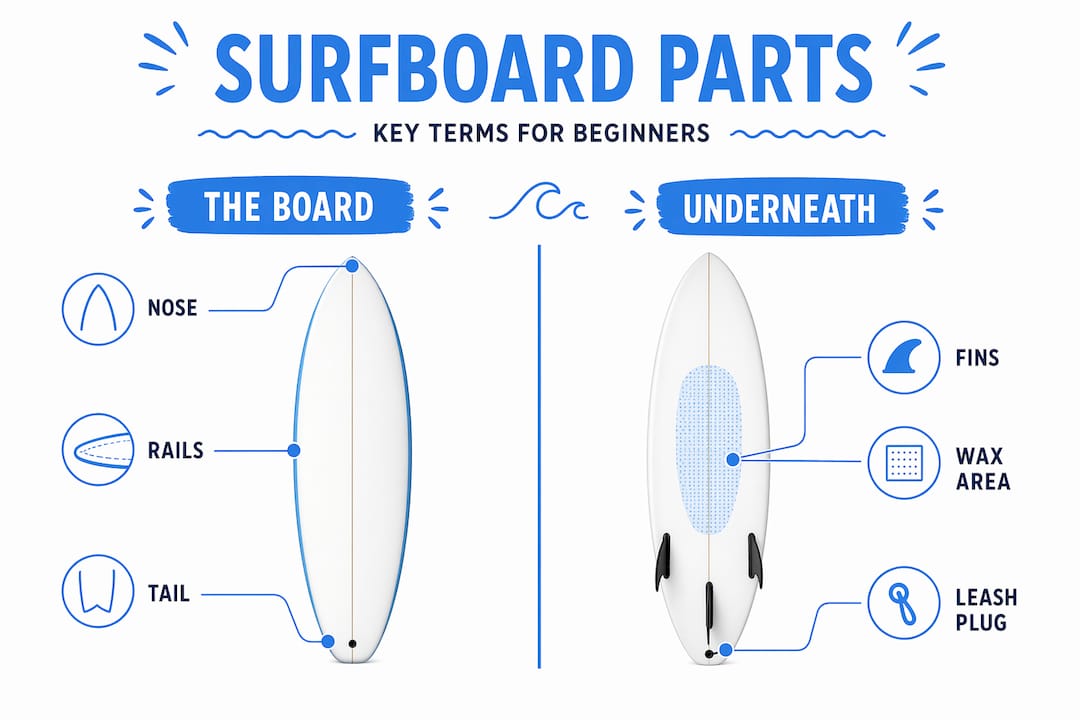
Fins are the fins underneath, and they control direction and stability. More fins generally mean more control. Wax is what you rub on the top of the board to stop your feet from slipping.
Two terms that confuse almost every beginner are volume and rocker. Volume, measured in liters, tells you how much buoyancy a board has. As board volume explains, it’s a more useful measure than length alone, since a thick, wide board can be short but float you easily. Rocker refers to the curve of the board from nose to tail. More rocker means more maneuverability but harder paddling.
Here’s a quick comparison of beginner-friendly board types:
Board type | Shape | Volume | Best for |
Softboard (foam) | Wide, thick | Very high | Day one beginners |
Malibu / Longboard | Long, round nose | High | Learning trim and flow |
Funboard | Mid-length, wide | Medium-high | Transitioning beginners |
Shortboard | Narrow, pointed | Low | Not for beginners |
Pro Tip: Don’t choose a board based on what looks cool. Choose it based on volume. A beginner needs enough float to paddle comfortably and pop up with confidence. Anything under 60 liters will feel like a punishment.
Ocean and wave condition terms you need to know
This section of the beginner surf glossary could save your life. Understanding wave and ocean terminology isn’t just useful. It’s a safety requirement.
The most fundamental concept is the break type. Beach breaks are safest and most beginner-friendly because they break over sand, which is forgiving when you fall. A reef break breaks over coral or rock. A point break wraps around a headland and tends to produce long, consistent waves. Both reef and point breaks require more experience.
Waves come in sets, which are groups of waves with intervals called lulls between them. The lull is your window to paddle out without getting hammered. Whitewater is the broken, foamy water after a wave has already crashed. Most beginner lessons start in the whitewater because it’s predictable and powerful enough to practice pop-ups without requiring wave-reading skills.
Here are the most critical ocean condition terms for beginners:
Swell: Energy traveling through the ocean that becomes waves as it hits shallow water
Glassy: Calm, smooth ocean surface with no wind. The best surfing conditions.
Chop: Rough, bumpy water caused by wind. Hard to paddle and ride in.
Offshore winds: Wind blowing from land out to sea. Creates clean, well-shaped waves.
Onshore winds: Wind blowing from sea to land. Creates messy, blown-out conditions.
Impact zone: The spot where waves break hardest. Stay out of here when paddling.
Rip current: A powerful channel of water moving away from shore. Swim sideways to escape, not against it.
Channel: The deeper water beside the break where you can paddle out without fighting waves.
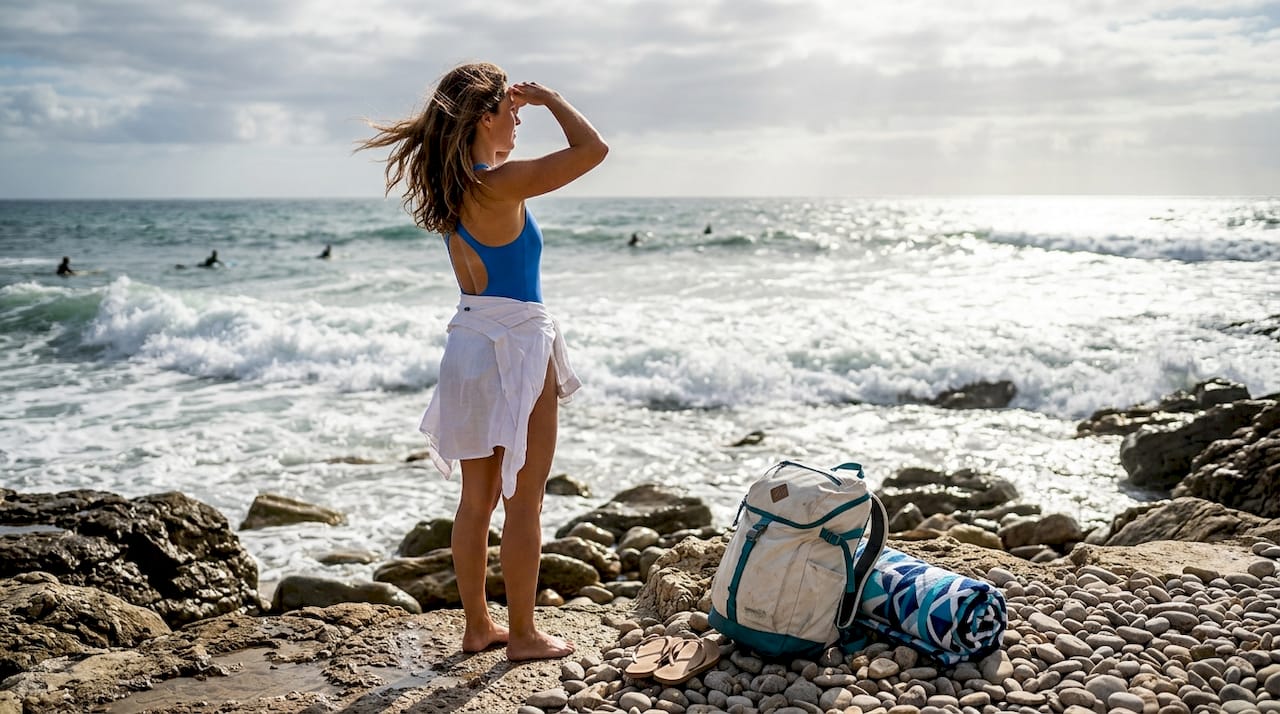
Pro Tip: Before you paddle out anywhere new, sit on the beach for 10 minutes and watch. Look for where the waves break, where experienced surfers paddle out, and whether there’s a visible rip. Portugal’s surf spots along the coast can have dramatically different conditions from beach to beach.
Surf etiquette and social terms every beginner must learn
Surf culture encourages a laid-back attitude but is governed by strict unwritten rules. Learn these social terms before you paddle out anywhere with other people in the water.
The lineup is the area where surfers wait for waves. It’s not chaotic. It has a social hierarchy based on priority, where the surfer closest to the peak of a breaking wave has the right to ride it. Ignoring this is the number one etiquette mistake beginners make.
Drop-in is the term for taking a wave from someone who already has priority. Taking a wave from a surfer who has priority is considered a major etiquette breach, and it’s also genuinely dangerous since two people on the same wave can collide badly.
Here are the key social and etiquette terms decoded:
Priority: The right to ride a wave; goes to the surfer closest to the peak
Snaking: Repeatedly paddling around someone to steal their position in the lineup
Burn: Another word for drop-in, used when someone takes your wave on purpose
Paddle battle: Two surfers competing for position to catch the same wave
Party wave: When multiple surfers ride the same wave together, usually by invitation only
Kook: A term for a surfer lacking ocean awareness and respect, not just skill. The label carries cultural weight beyond just being a beginner.
Grom: A young or junior surfer, typically under 16
Stoked: Excited, happy, pumped. Used constantly and sincerely in surf culture.
Hanging loose: The shaka sign or a relaxed, friendly greeting in surf communities
On stance, regular means left foot forward and goofy means right foot forward. Neither is better or faster to progress on. Your natural stance will reveal itself quickly. For a deeper breakdown, the surf stance guide at Riparsurfschool explains how to find yours and build balance from day one.
Pro Tip: You can avoid most etiquette problems by doing one thing: surfing the uncrowded part of the beach. As a beginner, give the peak to experienced surfers and practice on the shoulder where there’s less traffic and less pressure.
Maneuvers and action terms every beginner should recognize
When your instructor tells you to “pop up and do a bottom turn,” you need to know what that means. Here are the foundational surf maneuver terms in the order you’ll actually use them:
Paddle: Lying on the board and using your arms to move through the water. The foundation of everything.
Take-off: The moment you catch a wave and commit to standing up.
Pop-up: The motion of pushing up from lying flat to standing in one quick movement. This is the most drilled skill in beginner lessons.
Bottom turn: Your first real maneuver. At the base of the wave, you lean your weight to redirect up the face. It sets up every other move.
Frontside: Riding with your chest facing the wave. Most people find this easier to start.
Backside: Riding with your back to the wave. Requires more body rotation and spatial awareness.
Cutback: A turn that brings you back toward the power of the wave after you’ve ridden toward the shoulder.
Carving: Fluid, arcing turns on the wave face. The goal most beginners are working toward.
Wipe-out: Falling off your board. Happens constantly and is not a big deal once you learn to fall safely.
Turtle roll: A technique for getting through breaking waves while holding your board. You flip upside down and let the wave pass over you.
Barrel riding and nose riding are advanced concepts you’ll hear about but won’t need to practice for a while. A barrel is when the wave curls over the surfer completely. Nose riding is walking to the front of a longboard for style and trim. Both take years to develop.
Putting surf lingo to work in real sessions
Knowing the words is step one. Using them in context is where the learning compounds. When your instructor says “wait for the lull and paddle through the channel,” you now know exactly what to do and why. That kind of understanding speeds up your progress more than extra time in the water ever will.
Before every session, scan the conditions using the vocabulary you’ve learned. Is it glassy or choppy? Are there sets coming through regularly or is the swell inconsistent? Is there a visible rip, and is there a clear channel? These are not just academic questions. They are the checklist that experienced surfers run through automatically, and surfing terminology is the tool that makes those conversations precise and useful.
When things go wrong, vocabulary helps there too. Being able to tell someone “I got caught in a rip near the impact zone” is far more useful than “the water kept pulling me sideways and waves kept hitting me.” Clear communication speeds up help.
For a deeper look at how the lineup actually functions and how to read priority in real situations, the lineup beginner’s guide at Riparsurfschool walks through the social dynamics you’ll encounter in your first sessions.
Pro Tip: Spend time watching the locals and listening to how they talk about waves and conditions. You’ll pick up regional slang fast, and asking questions respectfully almost always gets a friendly response. Surfers appreciate when newcomers show genuine curiosity.
My honest take on why learning the language matters so much
I remember my first weeks in the water like it was embarrassing yesterday. Someone called out “snaking!” and I genuinely thought there was a snake in the ocean. I paddled out of the way of a surfer on a wave and accidentally dropped in on someone else behind me. I had no idea what I’d done wrong until much later.
What I’ve learned over years of teaching and surfing is that the terminology isn’t separate from the skill. It’s woven through it. When you know what a cutback is, your brain starts recognizing the shape of the turn in other surfers. When you understand priority, you stop drifting into dangerous situations because you actually know where you shouldn’t be.
The word “kook” gets thrown around casually, but I’ve seen it sting. What I’ve found is that it’s almost never about ability. Beginners get a pass on skill. What earns that label is carelessness, specifically when someone ignores the rules and risks hurting others. Knowing the etiquette terms protects you from that entirely.
My real advice is this: treat the language like part of the curriculum, not an afterthought. Read a beginner surf glossary before your first lesson, not after your fifth. Show up already knowing what a lineup is, what a drop-in means, and why volume matters. You’ll be safer, your instructor will be able to teach you faster, and the other surfers around you will treat you differently from the start.
— Fernando
Ready to practice your surf skills in Portugal?
At Riparsurfschool, based at Praia Areia Branca near Peniche, the instructors build terminology and etiquette into every session from day one. You don’t just learn to stand up on a board. You learn why things happen, what to call them, and how to communicate safely in the water.

Whether you prefer a social setting or one-on-one attention, there are group surf lessons and private surf lessons available to match your pace and learning style. The small-beach-village environment at Areia Branca means you get real surf culture without the crowds of a tourist hotspot. Book your lesson online and start your sessions already knowing the language.
FAQ
What are the most important surf terms for a beginner?
The most critical terms are drop-in, priority, lineup, impact zone, rip current, and pop-up. These directly affect your safety and your relationship with other surfers from your very first session.
What does “drop-in” mean in surfing?
A drop-in means taking a wave from a surfer who already has priority, which is the most common and serious etiquette violation. It can cause collisions and is considered disrespectful in every surf community.
What is the difference between regular and goofy stance?
Regular stance means your left foot is forward, and goofy stance means your right foot is forward. Neither stance is better. It comes down to personal preference and natural balance.
What is a beach break and why does it matter for beginners?
A beach break is a wave that breaks over a sandy bottom, making it the safest type of surf break for beginners. Reef breaks and point breaks break over harder surfaces and are better suited to more experienced surfers.
How does knowing surf terminology help you progress faster?
Understanding surf lingo and etiquette helps beginners follow instructor guidance more precisely, avoid dangerous situations, and earn respect in the lineup, all of which accelerate real-world skill development.
Recommended
Comments