

Surf Lineups Explained: A Beginner's Guide to Catching Waves

TL;DR:
The surf lineup is a designated area where surfers wait and position themselves to catch waves.
Priority is determined by position, waiting time, and who stands up first, with local rules influencing the order.
Respectful etiquette and communication are essential for safe, enjoyable surfing experiences in Portugal.
Most beginners think the hardest part of surfing is standing up on the board. Then they paddle out for the first time, drop in on someone else’s wave, and suddenly half the lineup is staring at them. The truth is, more surf conflicts happen in the water before a single wave is caught than most new surfers ever expect. Understanding how a surf lineup works, who gets which wave, and how to carry yourself out there is just as important as your pop-up technique. This guide breaks down everything you need to know: what the lineup is, how priority works, etiquette that keeps things friendly, and how to navigate it all as a beginner in Portugal.
Table of Contents
Key Takeaways
Point | Details |
Lineup demystified | The surf lineup is where surfers wait their turn for waves and follow shared rules. |
Priority matters | Knowing who goes first prevents conflict and leads to more enjoyable surfing sessions. |
Etiquette is essential | Good communication and respect for others are valued everywhere, especially in new spots. |
Local lessons help | Surf schools in Portugal teach etiquette and skills that make navigating the lineup much easier. |
What is a surf lineup?
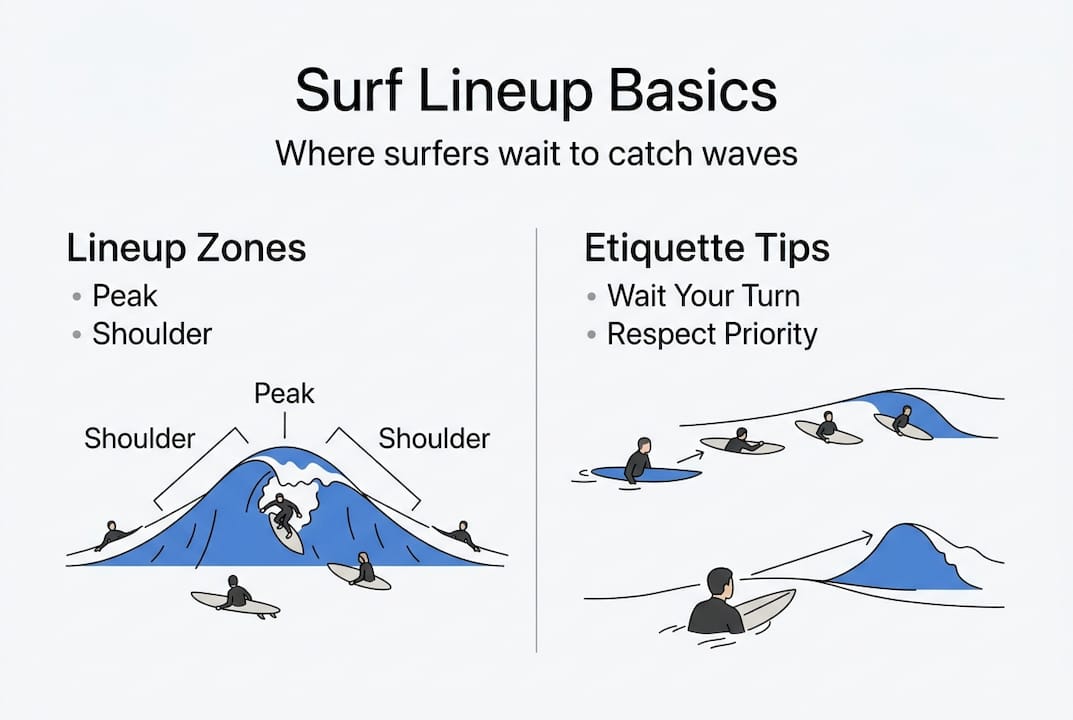
The surf lineup is not just a random cluster of people floating on boards. It is a specific zone in the ocean where surfers gather, wait, and position themselves to catch waves. Physically, it sits beyond where the waves are actively breaking, close to the spot called the peak, which is where waves first stand up and start to roll. Think of it like a queue at a popular restaurant, except everyone is bobbing in saltwater and the “table” is a moving wall of water.
Understanding the lineup’s purpose makes everything else click. As surfing-waves.com explains, a lineup is where surfers wait for waves and position themselves relative to the peak. That positioning is not random. It is a constantly shifting negotiation of space, timing, and unspoken social rules.
Here is why beginners find this so confusing: you cannot see a line. There is no painted floor, no ticket number, no host seating you. The “order” is invisible and changes every few minutes as waves come through and the crowd reshuffles. New surfers often either paddle too deep (too far out, missing all the waves) or sit in the impact zone (where waves crash, getting pounded) because they simply do not know where to be.
A few key terms worth knowing:
Peak: The point where the wave first breaks, usually the most desirable takeoff spot
Impact zone: Where broken whitewater lands, best avoided unless you are paddling through
Shoulder: The unbroken part of the wave, which rolls away from the peak
Sitting inside: Positioning closer to shore, usually lower priority but safer for beginners
“The lineup is not chaos. It is a community of people sharing a finite resource, and the rules exist to make that sharing fair and safe.”
If you are brand new to ocean surfing, beginner surf lessons will put you in the water with an instructor who explains all of this in real time, which speeds up the learning curve dramatically.
Lineup zone | Location | Beginner tip |
Peak | Deepest point, first break | Avoid until you’re confident |
Shoulder | Either side of peak | Great starting position |
Inside | Closer to shore | Safer but lower priority |
Channel | Deep water beside break | Use for easy paddle-out |
Lineup priority and rules: Who gets the wave?
Now that you know what the lineup is, the next thing to understand is who actually gets to ride each wave. This is called priority, and it follows a few clear principles.
According to widely recognized wave priority rules, priority is determined by who’s closest to the peak, furthest out, or up first. In practice, that breaks down like this:
Inside position: The surfer sitting closest to the peak (the spot where the wave first breaks) has the right of way.
Furthest out or longest wait: If two surfers are equally positioned, the one who has been waiting longest generally earns the next wave.
First to feet: If all else is equal, the first person to stand up on the board takes it.
Priority also shifts depending on the type of wave you are surfing. Beach breaks (waves that break over a sandy bottom) tend to have shifting peaks, so priority is more fluid and contested. Point breaks (waves that peel along a rocky headland in one consistent direction) create a cleaner, more structured queue.
Break type | Peak consistency | Priority style |
Beach break | Shifting, multiple peaks | Fluid, often informal |
Point break | Fixed, single direction | Structured queue system |
Reef break | Consistent, powerful | Strict, often local-heavy |
Edge cases make priority tricky. Dual peaks, where a wave breaks both left and right simultaneously, allow two surfers to go at once, one heading left and one heading right. In crowded sessions, you may notice informal rotations where the group quietly agrees to take turns. Heavy localism at certain spots means unwritten rules about who “owns” the peak can trump the standard priority system entirely.
Before paddling for any wave, run through this quick mental check:
Is anyone already riding this wave?
Am I in the inside position relative to the peak?
Is another surfer already paddling and committed?
Have I been waiting longer than others nearby?
Am I physically able to ride this wave safely?
Pro Tip: Study a surf etiquette guide before your first session. Knowing the rules before you paddle out is far less stressful than trying to decode them in real time while a set wave rolls in.
You can also review lineup priority rules as part of your preparation before booking lessons, since understanding your responsibilities in the water helps you get more out of every session.
Lineup etiquette and communication
Understanding rules is just the start. Surfing also runs on a layer of soft social skills that no rulebook fully captures. This is especially true for travelers joining a local lineup for the first time.
Here are the unwritten etiquette standards that every surfer is expected to follow:
Wait your turn. Even if you are in the right position, constantly catching every wave you can wears out your welcome fast.
Do not snake. Snaking means paddling around someone to get inside position at the last second. It is widely considered the most disrespectful move in the lineup.
Apologize when you mess up. Everyone drops in on someone accidentally at some point. A simple “sorry” goes a very long way.
Paddle wide when paddling out. Do not paddle straight through the lineup. Go around the breaking waves using the channel.
Call your direction. On a wave with two rideable directions, shout “left” or “right” so nearby surfers know where you are going.
As any experienced surfer knows, communication on dual peaks is essential, especially calling “left” or “right” before committing to a direction. One word prevents a collision.
“Etiquette is not about being timid. It is about being aware. The surfers who are most respected in the lineup are the ones who make the session better for everyone around them.”
At less crowded spots, you will find the culture far more relaxed and informal. Conversations happen. People share waves. Locals at smaller Portuguese beach villages are often genuinely friendly toward respectful visitors.
Pro Tip: Before joining any new lineup, sit and watch for at least 10 to 15 minutes. You will quickly spot who the respected regulars are, how the rotation works, and where beginners are paddling without getting in anyone’s way. Check the full etiquette guide for a detailed breakdown of every scenario you might face.
Taking group lessons is one of the fastest ways to practice this in a controlled, low-pressure setting. Your instructor, like the experienced team you can meet here, will model correct behavior and give you real-time feedback on your lineup conduct.
How to navigate the lineup as a beginner in Portugal
Armed with etiquette knowledge, the next step is putting it into action at real Portuguese surf spots. Portugal has some of Europe’s most celebrated waves, from the powerful beach breaks near Peniche to the more forgiving swells around Areia Branca. Each spot has its own personality, and navigating them confidently takes practice.
Here is a practical step-by-step for your first sessions:
Watch from shore first. Identify the peak, the channel, and where the beginners are sitting. Give yourself a mental map before entering.
Paddle out through the channel. This avoids the breaking waves and keeps you out of the way of surfers already riding.
Start on the shoulder or inside. As a beginner, you are not competing for the peak. Sitting slightly inside gives you safer, slower waves and keeps conflict low.
Pick your moments. Wait for a lull between sets to paddle out, and time your wave attempts when the lineup is a little clearer.
Exit safely. When you are done, ride a wave all the way to shore or paddle back through the channel, not across the active lineup.
Crowded conditions require extra patience. On busy summer days at popular spots, the lineup can feel overwhelming. In those moments, the best strategy is to stay relaxed, observe more, and paddle for fewer but better-chosen waves.
As fair sharing principles emphasize, the key to a healthy lineup is awareness and taking only what is reasonably yours. Quality over quantity always wins.
Pro Tip: Read more about practical surf coaching tips to understand how structured feedback accelerates your progress in the water. And if you are wondering whether this school is the right fit, find out why students choose it year after year.
Why the real surf lesson happens in the lineup, not on the beach
Here is something most surf guides will not tell you: the beach part of your lesson, the stance drill, the paddling technique, the pop-up practice, is just the rehearsal. The actual education begins the moment you sit in the lineup and have to navigate real people, real waves, and real social dynamics simultaneously.
We have watched hundreds of beginners come through over the years. The ones who progress fastest are rarely the most athletic. They are the ones who watch, listen, and treat the lineup as a shared space rather than a personal playground. They ask questions. They give waves away. They build trust with the locals around them.
That matters beyond Portugal too. A surfer who learns respectful lineup behavior at Areia Branca will feel at home in Bali, California, or the Canary Islands, because the social code travels. The technical skills take time. The attitude is a choice you can make right now.
As explored in the surf camp vs. school comparison, immersive surf experiences speed up both the technical and the social sides of learning. You are not just surfing more. You are watching more, absorbing more, and building the kind of water confidence that no single lesson can deliver on its own.
The best surfers in any lineup are quietly respectful. That is not a coincidence.
Level up your lineup skills with expert lessons
Putting lineup theory into practice is a whole different experience when you have a certified instructor reading the water beside you. At Ripar Surf School in Praia Areia Branca, lessons are designed to get you comfortable in real lineups, not just on flat sand.

Whether you prefer a focused private surf lesson or the dynamic energy of a group surf lesson, our instructors guide you through positioning, communication, and wave selection in live conditions. You will learn faster, make fewer mistakes, and actually enjoy the lineup instead of dreading it. Book your surf lessons today and start building real water confidence at one of Portugal’s most welcoming surf spots.
Frequently asked questions
What happens if I break surf lineup rules?
Breaking lineup rules typically leads to lost waves or tension with other surfers. Apologize quickly, step back from the peak, and respect the rotation going forward. Most surfers will forgive an honest mistake.
How can I know who has wave priority?
The surfer closest to the breaking wave’s peak, or who has waited the longest and stands up first, has priority. Inside position, longest wait, or first to feet are the three deciding factors.
Do surf schools in Portugal teach lineup etiquette?
Yes. Most surf schools include lineup rules and etiquette as a core part of beginner instruction. Ripar’s booking terms reflect the school’s commitment to safe, respectful sessions from day one.
Is lineup etiquette different in Portugal?
The core rules are universal, but local customs can add extra expectations at specific breaks. Watch the lineup before joining and ask your instructor about local spot norms before paddling out.
Recommended
Comments