

Surf Progression Explained: Advance Your Skills With Confidence

TL;DR:
Surf progression is a structured development of skills through defined milestones, not just time in water.
Using the right board for your skill level and receiving coaching accelerates improvement.
Focused practice, environment, and consistent feedback are key to fast, lasting surf progression.
Most surfers assume that if they just keep paddling out, improvement will come on its own. It won’t. Surf progression is defined by repeatable abilities, not by how many sessions you’ve logged or how many years you’ve been in the water. There’s a real structure to advancing your surfing, and once you understand it, everything changes. This guide breaks down what surf progression actually means, the stages you’ll move through, how board choice plays into it, and how to speed the whole process up with the right coaching and environment.
Table of Contents
Key Takeaways
Point | Details |
Surf progression defined | Advancing in surfing means meeting skill milestones, not just spending time in the water. |
Board choice matters | Choosing the right surfboard at each stage boosts confidence and learning. |
Coaching accelerates growth | Lessons and feedback help you progress faster by targeting repeatable skills. |
Stay focused on your own path | Your progression timing will be unique—track your milestones, not others’. |
What does surf progression really mean?
Let’s get one thing straight first. Time in the water is not the same as progress. You can surf every weekend for three years and still be stuck doing the same awkward pop-up on the same type of wave. That’s not a knock on anyone. It’s just the reality of how surfing works without a structured approach.
Surf progression is the structured development of surfing skills from beginner to advanced levels. It’s about moving through clearly defined milestones, each one building on the last. Think of it less like climbing a ladder and more like learning a language. You don’t just absorb it by being around it. You have to practice specific things in a specific order.
Here are the most common misconceptions that hold surfers back:
More time equals more skill. Not automatically. Repetition without correction just reinforces bad habits.
Bigger waves mean faster progress. Wrong. Surfing waves beyond your skill level is more likely to scare you off than build confidence.
You’ll “just feel” when you’ve improved. Feelings are unreliable. Measurable benchmarks are not.
Watching other surfers is enough. Observation helps, but it can’t replace hands-on feedback.
When you recognize where you actually are in your progression, something useful happens. You stop wasting sessions trying things you’re not ready for, and you start targeting the exact skills that will move you forward. That’s the immediate payoff of understanding surf progression as a structured path.
“The surfers who improve fastest aren’t the ones who surf the most. They’re the ones who surf with intention.”
If you’re just starting out, beginner surf lessons give you that structure from day one, so you’re building on a solid foundation rather than guessing your way through the early stages.
Key stages of surf progression: From beginner to advanced
Knowing where you stand is the first step to moving forward. Surf progression is not a vague spectrum. It has real, identifiable stages with specific skills attached to each one. Progression is defined by repeatable abilities, not by time or experience, which means you can honestly assess yourself right now.
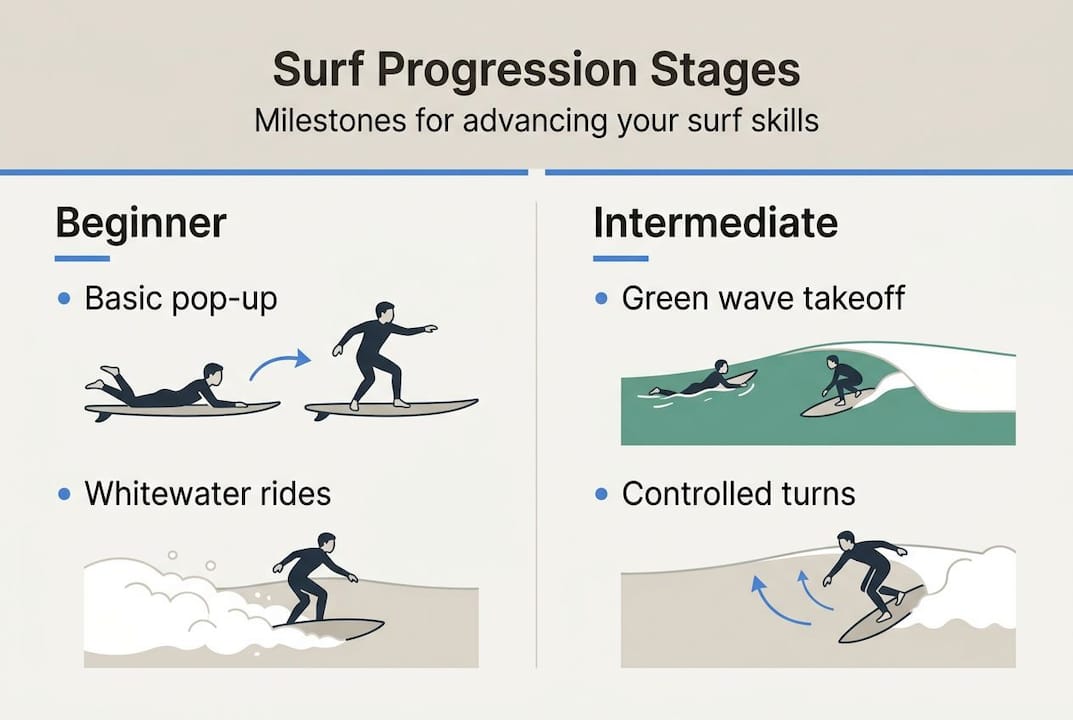
Here’s how the three main stages break down:
Stage | Key abilities | Typical challenges |
Beginner | Paddling, pop-up, riding whitewater | Balance, timing, reading waves |
Intermediate | Catching green waves, basic turns, trimming | Consistency, wave selection, footwork |
Advanced | Carving, tube riding, aerial awareness | Power, precision, wave reading at speed |
Let’s look at what each stage actually involves in practice:
Beginner: You’re learning to paddle efficiently, execute a pop-up (standing up on the board), and ride the whitewater (broken waves) toward shore. Success here means doing these things consistently, not perfectly.
Intermediate: You’re catching unbroken green waves, making your first real turns, and starting to read where a wave is going before it breaks. This stage is where most surfers spend the most time.
Advanced: You’re linking maneuvers, generating speed down the line, and making decisions in fractions of a second. Board control feels instinctive rather than deliberate.
Pro Tip: Film yourself surfing at least once a month. What feels smooth in the water often looks very different on video. Watching your own footage is one of the fastest ways to spot what’s holding you back.
If you’re between stages and not sure which skills to target next, beginner lessons can reset your foundation, while all levels private coaching gives you a personalized plan for wherever you currently sit.
Board progression explained: Choosing the right surfboard for your skill level
Your board is not just equipment. It’s a tool that either supports or limits your progression at every stage. Riding the wrong board for your skill level is one of the most common reasons surfers plateau.
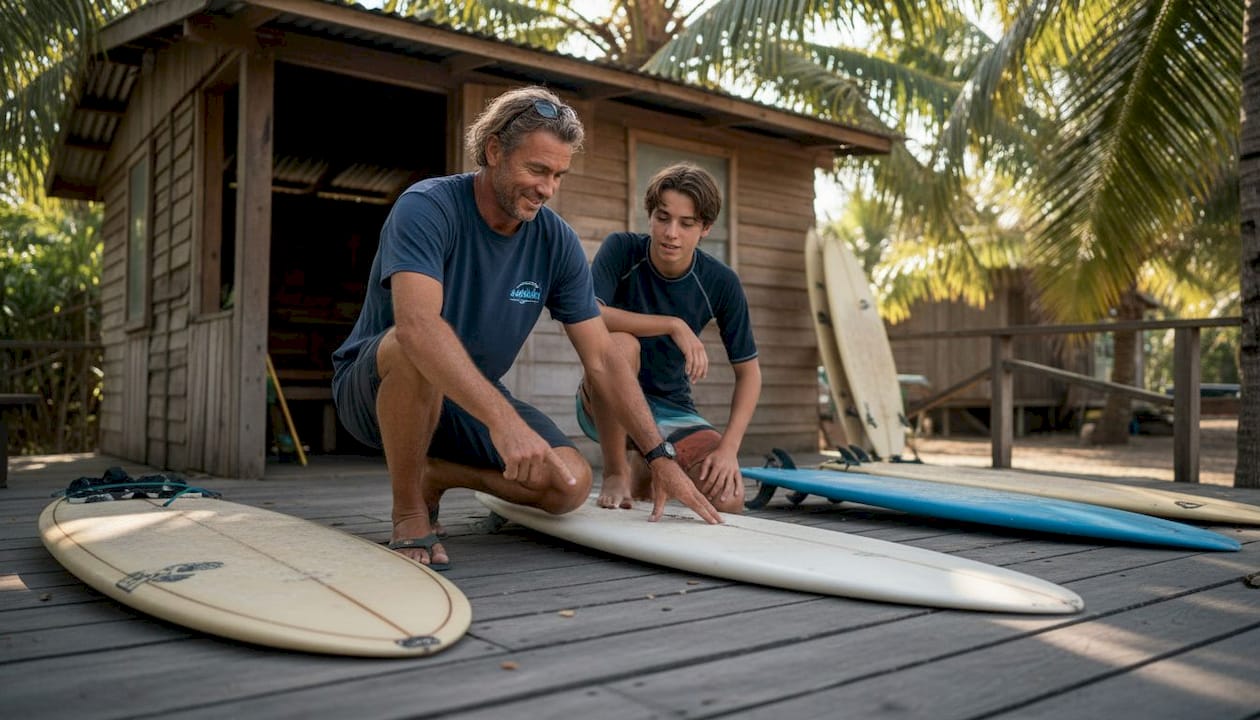
Here’s a simple breakdown of how board progression typically works:
Board type | Size range | Best for |
Longboard or foam board | 8 to 9 ft, high volume | Beginners learning to paddle and pop up |
Mid-length or fish | 7 to 8 ft | Intermediate surfers building turns |
Shortboard | Under 7 ft | Advanced surfers with strong wave reading |
The standard board progression path runs from a beginner longboard or foam board at 8 to 9 feet with high volume, to an intermediate mid-length or fish board in the 7 to 8 foot range, and eventually to a shortboard. Each transition comes with a learning curve, and rushing it slows you down.
Here’s why volume matters so much. A higher volume board floats better, paddles easier, and catches waves with less effort. That gives you more time to focus on your stance, your pop-up, and your balance. Drop the volume too soon and you’ll spend most of your session just trying to stay on the board instead of actually surfing it.
The steps to a smart board transition look like this:
Master consistent pop-ups and wave riding on your current board.
Identify which maneuvers feel limited by the board, not by your skill.
Try a slightly smaller or lower volume board in small, forgiving waves.
Ride it in multiple sessions before deciding it’s the right fit.
Only make the full switch when the new board feels like an upgrade, not a punishment.
Pro Tip: Don’t let ego drive your board choice. A bigger board that you surf well will always look better than a shortboard you can barely control. The best surfers in the lineup are usually on the right board for the conditions, not the smallest one they can find.
Understanding how equipment and skill interact is a big part of why surf coaching benefits go beyond just technique. A good coach will tell you honestly when your board is holding you back and when it’s actually you.
Accelerating your surf progression: Training, coaching, and surf trips
Self-teaching has real limits. You can’t see yourself from the outside, you can’t always identify what you’re doing wrong, and without feedback, bad habits get locked in fast. Guided instruction accelerates structured skill development in ways that solo practice simply cannot match.
Here’s a practical sequence for accelerating your progression:
Start with structured lessons. Even experienced surfers benefit from going back to basics with a certified instructor. You’ll fix ingrained habits faster than you think.
Get regular feedback. One session with a coach who watches you surf is worth more than ten sessions alone. They see what you can’t.
Surf consistently in the right conditions. Small, clean waves are better for progression than big, messy ones. Quality of practice beats quantity every time.
Book a surf trip or camp. Immersive environments accelerate progress dramatically. You surf more, you get more feedback, and you’re surrounded by people at similar stages.
Review and set micro-goals. After each session, note one thing that went well and one thing to work on next time.
Portugal is genuinely one of the best places in the world to accelerate your progression. The Atlantic coast near Peniche and Ericeira delivers consistent, varied waves across all skill levels, and the water is warm enough for comfortable sessions most of the year. The community atmosphere at surf camps in Portugal also plays a real role in keeping motivation high, which matters more than most people realize.
Pro Tip: Joining group surf lessons isn’t just about instruction. Watching other surfers at your level attempt the same skills, succeed, and struggle gives you perspective and motivation that solo sessions can’t provide.
A great surf instructor doesn’t just correct your technique. They help you understand why something isn’t working, which is the difference between a quick fix and a lasting improvement.
The truth about surf progression: What most surfers get wrong
Here’s something we’ve seen over and over after more than two decades of teaching surfing in Portugal. The surfers who struggle most are rarely the ones with the least talent. They’re the ones measuring their progress against someone else’s timeline.
Social media doesn’t help. You see someone posting clips of clean cutbacks after six months and assume you should be there too. But you don’t see how many hours they surfed, what conditions they had, or whether they had consistent coaching. Comparison is genuinely one of the biggest blockers to progression.
The real key is focusing on your own repeatable breakthroughs. Can you consistently pop up clean? Can you trim across a wave without losing speed? Can you pick the right wave three times in a row? Those small, repeatable wins are what progression actually looks like from the inside.
Surf trips and expert coaching reveal your true level faster than anything else. You strip away the comfort of familiar waves and familiar habits. That’s where real growth happens. At our surf school, we see students make more progress in one week than they did in months of surfing alone, not because we have a magic formula, but because structured, focused practice in the right environment simply works.
Progress is not linear. Some weeks you’ll feel like you’ve gone backward. That’s normal. What matters is the trend over time, not the feeling on any given Tuesday.
Ready to level up your surf progression in Portugal?
If this guide has made one thing clear, it’s that surf progression moves faster with the right support around you. Portugal’s Atlantic coast offers some of the most consistent and beginner-friendly waves in Europe, and having expert instruction alongside those waves is a combination that’s hard to beat.
At Ripar Surf School, we’ve been helping surfers at every level build real, lasting skills since 2001. Whether you want to book surf lessons for a focused few days, join a group surf lesson to learn alongside others, or fully commit to your progression with a book surf camp experience, we have the right option for where you are right now. Come surf with us in Praia Areia Branca and find out what real progression feels like.
Frequently asked questions
How long does it take to move from beginner to intermediate surfer?
Progression is based on repeatable skills, not just time in the water. With consistent practice and structured coaching, many surfers reach intermediate milestones within one to two seasons, though the timeline varies for everyone.
What are the signs that I’m ready to transition to a smaller surfboard?
You’re ready when you can consistently catch waves, control your direction, and perform basic turns with confidence. Board progression follows ability to execute essential maneuvers reliably, not the number of sessions you’ve completed.
Can taking surf lessons really speed up my progression?
Yes, significantly. Guided instruction accelerates skill development by providing real-time feedback that self-teaching simply cannot replicate, helping you correct mistakes before they become permanent habits.
Is it better to learn surfing in a group or with private coaching?
Both work well depending on your goals. Group lessons build motivation and let you learn from watching others, while private coaching delivers personalized feedback tailored exactly to your current skill gaps.
Why is Portugal a recommended destination for surf progression?
Portugal offers consistent Atlantic waves across all skill levels, certified local instructors, and a relaxed surf culture that supports learning at every stage of progression.
Recommended
Comments