

Surf Equipment Guide for Beginners in Portugal 2026

TL;DR:
Beginners should choose foam boards with appropriate volume for stability and faster learning.
Proper leash length and thickness are essential for safety and ease during wipeouts.
Simplifying gear focus enhances progress and enjoyment in Portugal’s surf conditions.
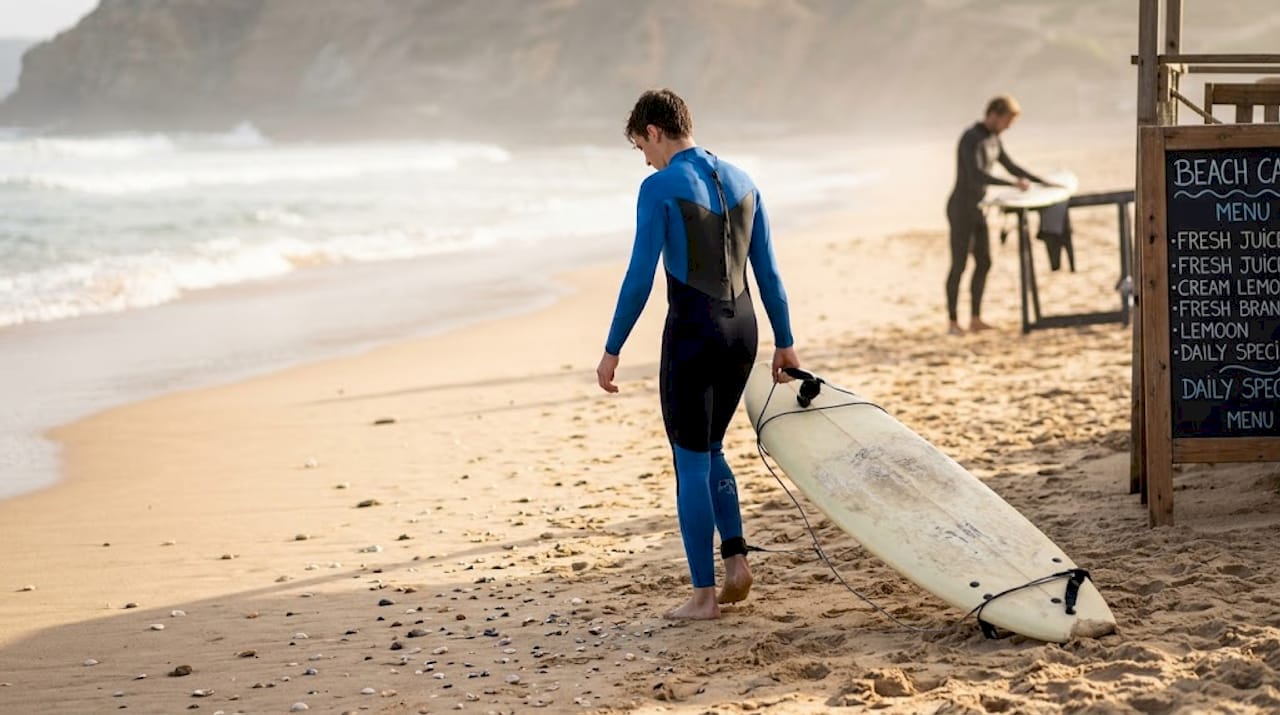
Picking your first surf gear feels like being handed a foreign-language menu with no translator. Boards come in dozens of shapes, leashes in confusing thicknesses, wetsuits in a maze of millimeter ratings. For beginners heading to Portugal’s famous Atlantic breaks near Peniche or Ericeira, the wrong choices don’t just waste money. They slow down your progress and drain the fun right out of your first sessions. The good news is that the right setup is simpler than the surf industry wants you to believe. This guide cuts through the noise and gives you clear, expert-backed steps to choose gear that actually helps you learn faster and enjoy every wave.
Table of Contents
Key Takeaways
Point | Details |
Foam boards first | A foam surfboard sized to your weight makes learning safer and faster for beginners. |
Match leash to board | Your leash should equal board length and thickness should fit surf conditions for safety. |
Wetsuit by water temp | Choose wetsuit thickness based on Portugal’s region and season for maximum comfort. |
Skip unnecessary gear | Focus on essential accessories and avoid overpacking to streamline your surf experience. |
Local rentals help | Renting regionally matched equipment often beats buying advanced gear for your first sessions. |
Choosing your first surfboard: Foam, size, and volume explained
Your surfboard is the single most important piece of equipment you will own as a beginner, and getting it right makes everything else easier. The surfing world is full of beautiful, sleek shortboards that look incredible in photos. Ignore them for now. They are designed for experienced surfers who have already developed balance, paddling strength, and wave-reading instincts. You need something very different.
Foam surfboards, often called “foamies” or “softboards,” are the gold standard for new surfers. They are buoyant, forgiving when you fall, and stable enough to help you practice standing up without fighting the board. The key measurement to focus on is volume, expressed in liters. Volume determines how much the board floats you on the water. More volume means more stability, which means more time standing instead of swimming.
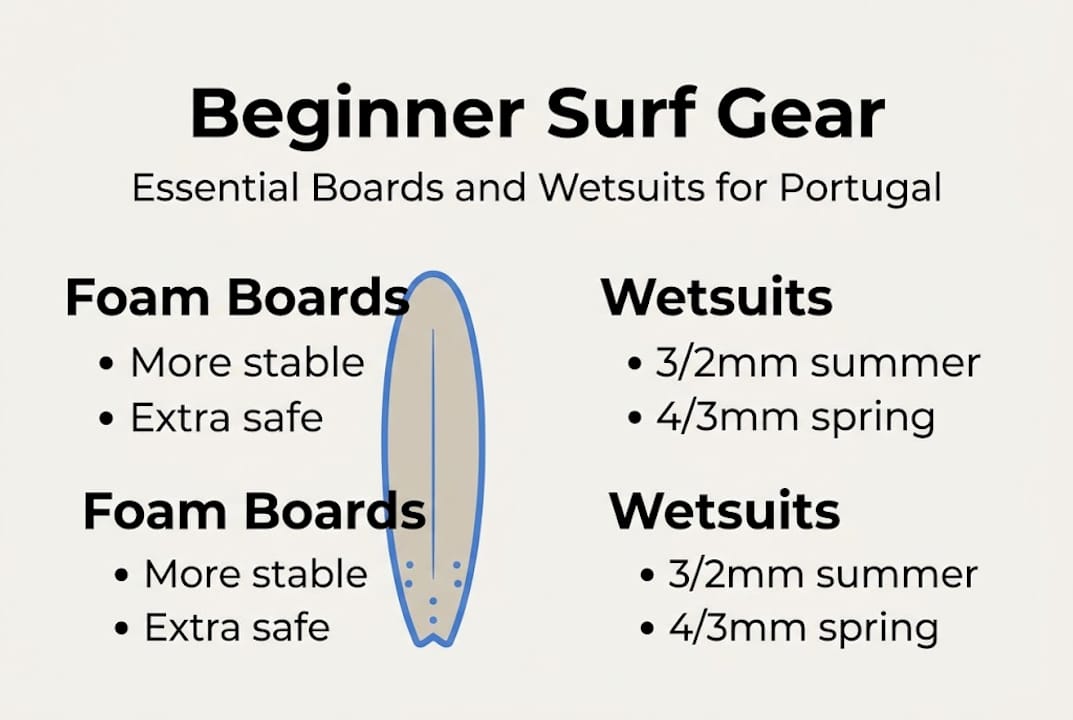
A practical formula used by surf coaches worldwide: multiply your body weight in kilograms by 1.8 to 2.2 to find your ideal volume range. So a 60kg surfer needs roughly 108 to 132 liters, which typically translates to a board around 8’0" to 9’0" long. Beginner surfers should prioritize foam surfboards 7’ to 9’ long with volume matched to body weight for maximum stability.
Board length | Width | Volume | Ideal weight range |
7’0" | 21" | 50–60L | 45–55kg |
7’6" | 22" | 60–75L | 55–65kg |
8’0" | 22.5" | 75–90L | 65–75kg |
8’6" | 23" | 90–105L | 75–90kg |
9’0" | 23.5" | 105–120L | 90kg+ |
Here is a simple process for choosing your board:
Calculate your target volume using the formula above.
Match that volume to a foam board in the 7’ to 9’ range.
Look for a round nose, which makes paddling easier and catching waves more forgiving.
Confirm the board has a soft, flexible fin setup for safety.
Test it in shallow water before committing to a full session.
For beginner surf gear picks in Portugal specifically, renting from a local surf school is a smart move. Local instructors know which boards perform best on the regional beach breaks around Areia Branca and Peniche, and they can match you to the right size on the spot.
Pro Tip: A round-nose foam board with extra volume feels slow on flat water but becomes your best friend the moment a wave picks you up. Prioritize float over style every single time.
“The right board does half the teaching for you. When a beginner is on the correct volume, they spend more time on their feet and less time frustrated in the water.” — Ripar Surf School instructor
Essential leash selection: Length, thickness, and setup
Once your board is sorted, the leash might seem like a minor detail. It is not. A leash is the cord that connects your ankle to your board, and it does two critical jobs: it keeps your board from becoming a projectile that hurts other surfers, and it stops you from swimming a hundred meters to retrieve it after every wipeout.
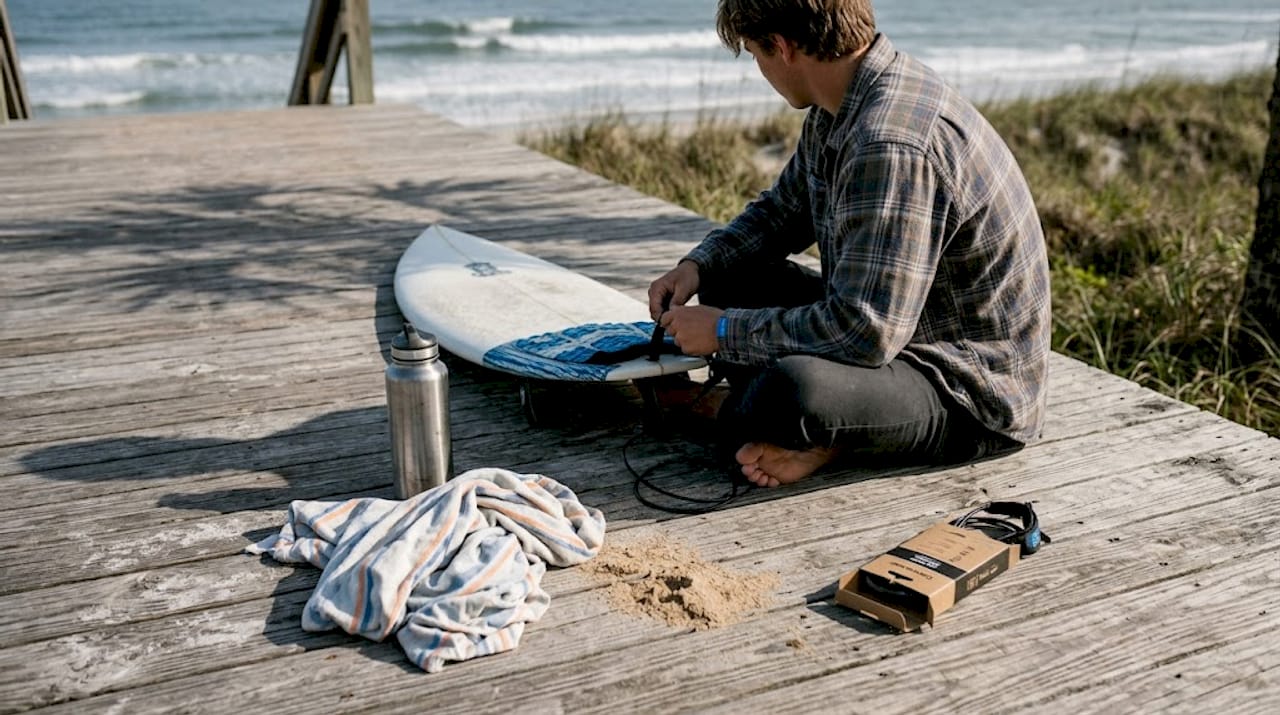
The rule for leash length is simple. Leash length matches board length, with a polyurethane cord 5 to 8mm thick based on wave size. If you are riding a 7’6" board, use a 7’6" leash. As a beginner, going one size longer than your board is actually a smart move. It gives the board a little more distance from your body when it gets dragged toward you in a wipeout.
Thickness matters just as much as length. Here is a quick comparison:
Leash thickness | Wave size | Best for |
5.5mm | 1–3ft (small) | Calm beginner days |
6mm | 3–5ft (medium) | Most beginner sessions |
7mm | 5–8ft (larger) | Intermediate and up |
8mm | 8ft+ (big swell) | Advanced surfers only |
For Portugal’s beach breaks, most beginner sessions happen in 2 to 4ft surf, so a 6mm leash is a reliable all-around choice.
When shopping for a leash, look for these key features:
Swivel joint: Prevents the cord from tangling around your legs during wipeouts.
Rail saver: A wide fabric strap that protects your board’s edge where the leash attaches.
Padded ankle cuff: Reduces friction and irritation during long sessions.
Double-knot string tie: The small string that connects the leash to the board plug should always be double-knotted.
Most beginner injuries and gear losses are avoidable with a properly fitted leash, yet it is one of the most overlooked pieces of essential leash picks for new surfers.
Pro Tip: Always check your leash string before paddling out. Portugal’s Atlantic beach breaks can produce powerful shore dumps that snap a worn string instantly. A quick 10-second check saves you a long swim.
Wetsuits and surf wax: Comfort, safety, and regional advice for Portugal
Portugal sits on the Atlantic coast, and the water is cooler than most first-timers expect. Even in summer, sea temperatures along the central and northern coast hover between 17°C and 20°C. That is refreshing for about 30 seconds, then uncomfortable for the next two hours if you are wearing the wrong wetsuit.
Wetsuits trap a thin water layer against your skin for insulation, and thickness guides regional use. The thicker the suit, the warmer you stay, but also the less flexible you feel. Here is a practical breakdown for Portugal:
South Portugal (Algarve), summer: 3/2mm wetsuit is sufficient.
Central Portugal (Peniche, Areia Branca), summer: 3/2mm works, but a 4/3mm adds comfort on windier days.
North Portugal, spring and autumn: 4/3mm is the reliable choice.
Winter, anywhere in Portugal: 5/4mm with boots and gloves for extended sessions.
For more detail on seasonal water temperatures, check out Portugal surf water temps to plan your trip around the right gear.
Surf wax is the grippy coating you apply to the top of your board so your feet do not slide off. It comes in four temperature ratings: cold, cool, warm, and tropical. Using the wrong temperature wax is a surprisingly common mistake. Warm-water wax melts and smears in cold Atlantic water, leaving a slippery mess. Cold-water wax stays firm and grippy even when the ocean is chilly.
For most of Portugal, cool or cold water wax is the right call from October through May. In summer, cool wax works well for the central coast. Apply in a crosshatch pattern, then add a top coat in circular motions for maximum texture.
Pro Tip: Reapply a light coat of cold-water wax midday during long sessions on Portugal’s Atlantic beaches. Sun and saltwater wear it down faster than you expect, and fresh wax makes a noticeable difference in grip.
For packing guidance before your trip, the Portugal surf camp gear guide covers everything you need to bring and what you can rent on arrival.
Must-have accessories and what to skip: Fins, bags, and repair kits
Once you have your board, leash, wetsuit, and wax sorted, the accessory market will try very hard to sell you more things. Most of it is unnecessary for beginners. Here is an honest breakdown of what actually matters.
Must-have accessories:
Fins: Your foam board likely comes with soft rubber or plastic fins. Keep them. They are safer than fiberglass fins if you or another surfer takes a hit.
Board bag: A padded board bag protects your board during travel and from UV damage between sessions. Even a basic day bag is worth it.
Repair kit: A small ding repair kit with UV-cure resin and sandpaper handles minor cracks before they become expensive damage.
Fin key: A small tool for tightening removable fins. Lose it once and you will always carry a spare.
What to skip for now:
Advanced carbon fiber fins designed for high-performance shortboards.
Surf watches and GPS trackers that log wave counts.
Traction pads designed for the tail of shortboards.
Fancy board covers with complex locking systems.
Foam boards and accessories such as appropriately sized leashes and proper wax are far more valuable investments than flashy extras for new surfers. The best surfers in the water at any Portuguese break are not the ones with the most gear. They are the ones who know their equipment well.
For your first sessions, consider renting everything except your personal wetsuit for hygiene reasons. A well-stocked accessory starter kit from a local school covers the rest without the upfront cost.
Pro Tip: Travel light. A foam board, leash, wetsuit, and wax block fit into a single board bag. You do not need a second checked bag of gadgets to have an amazing surf trip in Portugal.
Rethinking surf gear: Why less is more for new surfers in Portugal
Here is something the surf industry will never tell you: most beginners improve faster with less gear, not more. We have seen it consistently at Ripar over more than two decades of teaching surfers at Areia Branca. The students who arrive with a simple foam board, a good leash, and a properly fitted wetsuit outpace the ones who show up with a quiver of boards and a bag full of accessories.
The reason is focus. When your setup is simple, your attention goes to the wave, your body position, and your timing. When your setup is complicated, you spend mental energy managing equipment instead of learning to surf.
Renting well-matched gear from a local school in Portugal also beats transporting or buying advanced models before you are ready. Local instructors know the specific conditions at their beach, and they will put you on the right board for the right day. That kind of matched guidance is worth more than any piece of equipment you could buy online.
“Focus on the waves, not the gadgets. Your best sessions will always be on simple gear you understand.” — Ripar Surf School instructor
If you want to understand why less gear works in a learning environment, it comes down to one thing: clarity. Simple gear gives you clear feedback. And clear feedback is how you get better, faster.
Take the next step: Book your surf experience in Portugal
Now that you know exactly what gear you need and why, the most exciting part begins: actually getting in the water. At Ripar Surf School and Surfcamp Portugal, we have been helping beginners go from confused to confident since 2001 at Praia Areia Branca, near Peniche and Ericeira.

When you book surf lessons with us, all the equipment decisions we covered here are handled for you. We provide foam boards matched to your size, proper leashes, and wetsuits suited to the season. Our certified local instructors guide every session with the kind of hands-on, personalized attention that accelerates real progress. Whether you want a single session or a full surf camp week, our all levels private surf lesson options are designed to meet you exactly where you are.
Frequently asked questions
What size surfboard should a 70kg beginner in Portugal start with?
A 7’6" to 8’0" foam surfboard with 55 to 65L volume is ideal for a 70kg beginner, providing maximum stability and buoyancy for learning.
Do I need a thick wetsuit for summer surfing in Portugal?
For summer sessions, a 3/2mm wetsuit is comfortable in southern Portugal, but a 4/3mm is a smarter choice for spring or the northern coastal regions where water stays cooler.
How do I know what leash to buy for my surfboard?
Choose a leash the same length as your board with a 5 to 8mm cord thickness, going thicker for bigger waves or extra security in powerful beach breaks.
Is surf wax really needed for foam boards?
Yes. Even foam boards benefit from wax, and using the correct temperature-rated wax prevents slipping in Portugal’s cold Atlantic waters, especially during longer sessions.
Recommended
Comments