

Why Consistent Practice in Surfing Builds Real Skill

TL;DR:
Consistent surfing practice is essential for improving muscle memory, reactive balance, and paddle endurance, which are key skills that fade without regular engagement.
Sharing water time frequently, even in short sessions or controlled environments like wave pools, accelerates progress and helps surfers break through plateaus.
Consistent practice in surfing is the single most reliable driver of skill development, muscle memory, and wave-readiness. Surfing demands a rare combination of balance, paddling endurance, and real-time ocean reading. None of those abilities develop from occasional sessions. The sport is uniquely challenging because it offers far fewer repetitions per hour than almost any other skill-based activity. Crowds, inconsistent swell, and short rides all cut into your wave count. Understanding why consistent practice in surfing matters, and how to structure it, is what separates surfers who plateau from those who genuinely progress.
How does consistent practice improve surfing skills?
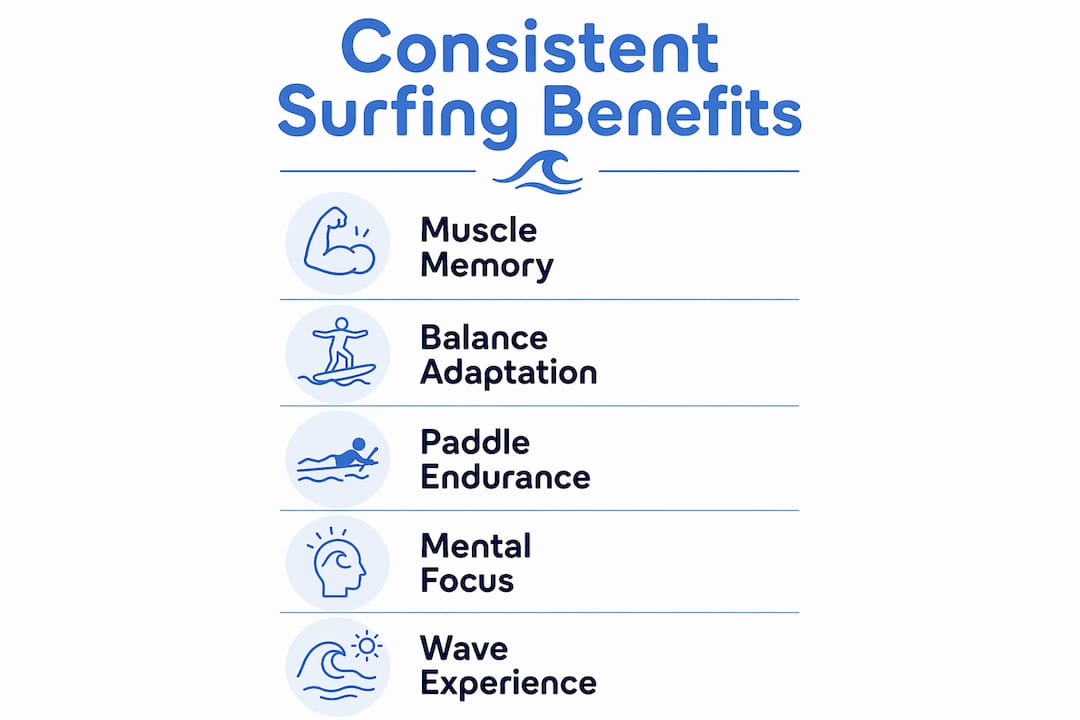
Consistent surfing practice builds skill through three overlapping mechanisms: muscle memory, balance adaptation, and paddle endurance. Each one reinforces the others, and all three require regular engagement to stick.
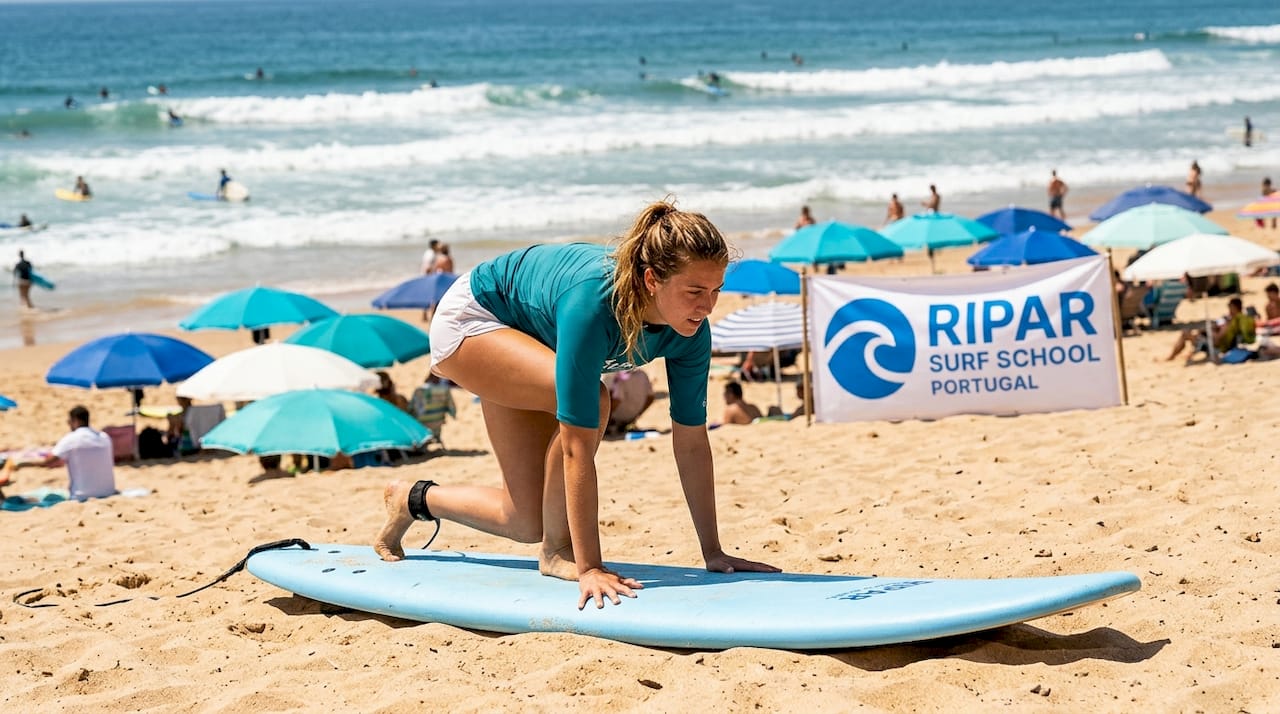
Muscle memory in surfing forms through repetition of the pop-up, weight shifts, and paddle strokes. Your nervous system encodes these movements only after hundreds of correct repetitions. Miss two weeks of surf, and that encoding starts to fade. This is why surfers who get in the water three to four times per week progress noticeably faster than those who surf once a week, even if total hours are similar.
Balance is the second mechanism, and it is more complex than most surfers realize. Balance-board training on a wobble platform transfers better to surfing than static drills and accelerates learning to stand up. The reason is that surfing demands anticipatory and reactive balance, not the static kind you use standing still. Your body learns to predict and respond to movement, and that skill only sharpens through repeated exposure to unstable surfaces, whether a wave or a wobble board.
Paddling endurance is the third mechanism, and it is often the most overlooked. Competitive surfers spend most of their wave time paddling, making shoulder endurance the real limiting factor for beginners. If you fatigue after 20 minutes, you lose wave count, and wave count is how you accumulate the repetitions that drive improvement.
Muscle memory forms through repeated pop-ups, turns, and paddle strokes across many sessions
Reactive balance sharpens through consistent exposure to unstable, moving surfaces
Paddle endurance determines how many waves you can actually catch per session
Ocean reading develops only through time in the water across varied conditions
Pro Tip: Track your wave count per session, not just your time in the water. Surfers who actively chase more waves per hour improve faster than those who paddle out and wait.
What are the challenges of inconsistent surfing practice?
Surfing is a low-repetition sport hindered by crowds, short rides, and inconsistent waves, making wave count through frequent sessions critical. This structural reality is what makes consistency so hard to maintain and so important to protect.
Most adults face a familiar set of obstacles: work schedules, family commitments, and distance from the beach. Professional surfers surf multiple times daily for years, creating a skill gap that casual surfers cannot close without deliberate strategy. The solution is not to surf more hours in one weekend session. It is to surf more frequently across the week, even in shorter bursts.
Surf slumps are another real challenge. Every surfer hits a period where nothing clicks, waves feel wrong, and progress stalls. Experienced surfers treat this as a normal phase. The “just keep paddling out” mantra is not motivational fluff. It reflects the reality that consistency through a slump is what breaks it. Changing one variable at a time, whether your board, your stance, or your session timing, helps identify what is holding you back.
Here are four practical strategies for maintaining consistency when conditions or life get in the way:
Time your sessions around tide and crowd patterns. Early morning sessions at less popular breaks give you more waves per hour than peak afternoon crowds at a main break.
Add a secondary surf location to your rotation. Different breaks expose you to different wave types, which accelerates surf skill development and prevents boredom.
Use wave pools strategically. Wave pools provide controlled, consistent conditions that amplify learning by increasing wave count and quality. A single wave pool session can deliver more quality repetitions than a week of average beach days.
Plan a dedicated surf trip once or twice a year. Surf trips with consistent conditions accelerate learning much faster than local breaks because you remove every logistical barrier at once.
Pro Tip: If you can only surf twice a week, make one session focused on a specific skill, such as your bottom turn or paddle technique, rather than just free surfing. Deliberate practice compounds faster than casual repetition.
How to balance dry-land training with actual surf time
Dry-land training supports surfing progress, but only when it targets the right physical qualities. The most common mistake is spending too much time on stable-surface pop-up drills. Pop-up drills on stable surfaces improve the standing motor pattern but do not transfer the balance demanded on moving waves. You are training the wrong environment.
The fix is to shift dry-land balance work onto unstable surfaces. Wobble boards, balance discs, and single-leg exercises on foam pads all train the reactive balance system that surfing actually uses. Six weeks of wobble-board work cuts ankle sprain risk significantly, which matters for surfers who train hard and want to stay in the water. Injury prevention is part of consistency.
Paddling endurance training is the other high-return dry-land investment. Resistance band paddling-specific training extends wave time per session, with one study group sustaining an additional 14 minutes of wave time and lower fatigue after 8 weeks. That is a meaningful gain in wave count per session, which compounds across a season.
Training type | Best use | Limitation |
Stable-surface pop-up drills | Building the standing motor pattern | Does not transfer surf balance |
Wobble-board balance work | Reactive balance and ankle stability | Requires consistent weekly sessions |
Resistance band paddling | Shoulder endurance and paddle power | Must mimic actual paddle mechanics |
In-water surf sessions | Wave reading, timing, full skill integration | Limited by conditions and access |
The best routine combines short pop-up reps on a balance disc with two to three resistance band paddling sets, three times per week on non-surf days. This keeps your body primed for the water without replacing actual surf time.
How does routine surfing contribute to mental and physical well-being?
The benefits of regular surfing extend well beyond skill development. Surfing as a consistent practice reshapes your physical fitness, mental state, and daily structure in ways that most other sports do not.
Dawn patrol surfing promotes mental clarity, reduces depression risk, boosts mood, and fosters disciplined routine. Early morning surfers report more structured days and stronger mental health outcomes. The reason is partly neurological. Cold water immersion and physical exertion trigger endorphin and dopamine release, and doing this before the day’s demands begin sets a positive neurological baseline that carries forward for hours.
The physical benefits are equally real:
Cardiovascular fitness improves through sustained paddling, which is a full upper-body aerobic workout
Core strength and balance develop through constant stabilization on the board
Spatial awareness sharpens through reading wave sets, judging distances, and reacting to other surfers
Sleep quality improves with regular physical exertion and time outdoors in natural light
“Surfing is one of the few sports where the environment itself is the training partner. The ocean never gives you the same session twice, which keeps your nervous system engaged and your mind fully present.”
The mental discipline that comes from consistent dawn patrol sessions also creates a feedback loop. Surfers who commit to a morning routine report lower anxiety, better focus at work, and a stronger sense of personal agency. The ocean does not care about your schedule or your mood. Showing up anyway builds a kind of mental resilience that transfers directly into other areas of life.
Key takeaways
Consistent practice in surfing is the non-negotiable foundation for skill retention, physical fitness, and mental well-being, and no amount of occasional surfing replaces it.
Point | Details |
Muscle memory requires repetition | Frequent sessions encode pop-up and paddle mechanics that fade without regular practice. |
Reactive balance beats static drills | Wobble-board training transfers to surfing; stable-surface pop-ups do not. |
Paddle endurance limits wave count | Resistance band training adds measurable wave time per session over 8 weeks. |
Surf slumps are normal | Persistence through plateaus, combined with small variable changes, breaks stagnation. |
Mental benefits compound over time | Regular surfing reduces anxiety, improves sleep, and builds daily discipline. |
What 20 years of watching surfers progress taught me
I have watched hundreds of surfers come through Praia Areia Branca over the years, and the pattern is always the same. The surfers who improve fastest are not the most athletic or the most naturally gifted. They are the ones who show up consistently, even when the waves are average, even when they are tired, even when they had a frustrating session the day before.
The concept of “intermediate purgatory” is real. It is that frustrating zone where you can catch waves but cannot link turns, where you feel stuck for months. Every surfer I have seen break through that plateau did it the same way: more water time, more focused repetitions, and a willingness to surf conditions they found uncomfortable. Nobody surfed their way out of a plateau by waiting for perfect waves.
The other thing I have learned is that dry-land training is not a substitute for the ocean. It is a supplement. Surfers who spend 90% of their training time on a balance board and 10% in the water do not progress. The ones who flip that ratio and use dry-land work to extend their capacity in the water, those are the ones who genuinely advance. If you want to understand how surf coaching accelerates this process, the feedback loop from an experienced instructor is something no amount of solo practice fully replaces.
Make consistency a lifestyle element, not a goal. The surfers who treat surfing as a non-negotiable part of their week, like sleep or meals, are the ones still improving at 40 and 50.
— Fernando
Build your surfing consistency with Riparsurfschool
Riparsurfschool has been running structured surf lessons and surf camps at Praia Areia Branca, near Peniche and Ericeira, since 2001. The location delivers consistent Atlantic swell across all skill levels, and the certified local instructors provide the kind of session-by-session feedback that turns inconsistent practice into measurable progress.

Whether you are a beginner building your first group surf lesson routine or an intermediate surfer looking to break a plateau with targeted coaching, Riparsurfschool structures each session to maximize your wave count and skill retention. Surf camps remove every logistical barrier at once, giving you the concentrated repetitions that accelerate progress faster than months of weekend sessions at home. Book your sessions and start building the consistency that actually moves the needle.
FAQ
Why is consistent practice in surfing so important?
Consistent practice builds the muscle memory, reactive balance, and paddle endurance that surfing demands. Without regular sessions, these skills fade between outings and progress stalls.
How often should you surf to improve?
Surfing three to four times per week produces noticeably faster improvement than once-weekly sessions, even if total hours are similar. Wave count per week is the key variable.
Can dry-land training replace time in the water?
Dry-land training supplements but does not replace surf time. Wobble-board balance work and resistance band paddling extend your capacity in the water, but ocean reading and wave timing only develop through actual surfing.
What causes a surf slump and how do you get through it?
Surf slumps are normal phases of plateau caused by repetition without variation. The most effective response is to keep paddling out while changing one training variable at a time, such as board size, break location, or session timing.
Do wave pools help with surfing consistency?
Wave pools create controlled, repeatable conditions that increase quality wave count significantly. They work best as a periodic supplement to ocean practice, particularly when local conditions are poor or crowded.
Recommended
Comments